


Magical Thinking and Unhelpful Beliefs

posted 6th January 2026
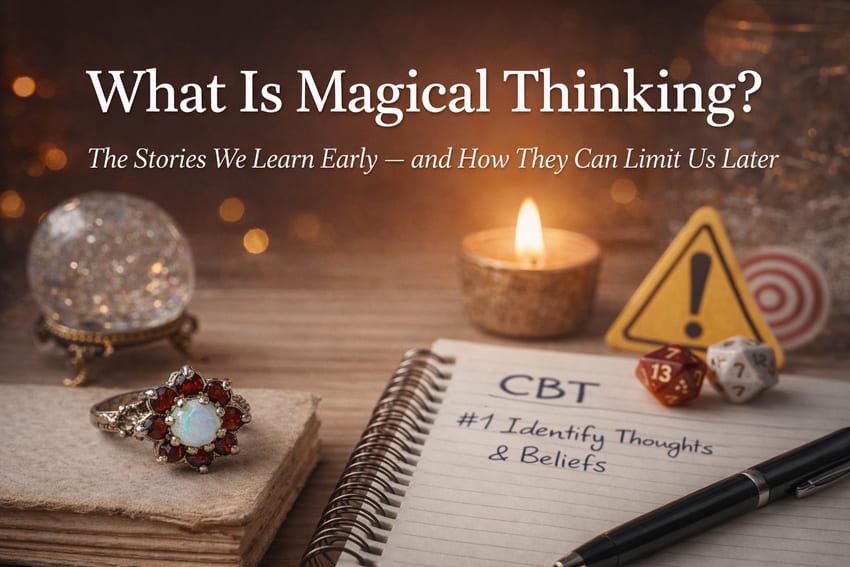
“It Was Always Unlucky”: A CBT Look at Magical Thinking and When Beliefs Take Over
In cognitive behavioural therapy (CBT), we often meet individuals who carry beliefs that feel unquestionably true, even when they recognise — at some level — that the belief doesn’t make logical sense. These beliefs are rarely about logic; they are about meaning, emotion, and how we attempt to make sense of events that once felt significant.
A client story involving an opal ring illustrates how magical thinking forms, how it can become reinforced over time, and how — in some cases — these beliefs can expand into patterns that interfere with daily life.
As a child, this client owned a small silver ring set with an opal. One day, the ring became stuck on their finger, and it had to be cut off. For a child, this was a frightening event. Shortly afterwards, an adult said simply, “Opals are unlucky.” That explanation — though based in folk belief rather than fact — provided the child with an immediate framework for understanding something distressing. It reduced uncertainty and made sense of an emotionally charged moment. In CBT, we understand that beliefs formed under emotional duress can become encoded in memory not as neutral facts, but as interpretations tied to feeling.
Years later, the client encountered a similar opal ring and noticed a familiar thought come up: “This is unlucky.” This was an automatic thought — fast, emotionally charged, and accepted without question because it had never been revisited. In CBT terms, these early beliefs can persist not because they are true, but because they are familiar and have not been examined.
Most of the time, beliefs like “opals are unlucky” remain mild superstitions, like being wary of walking under ladders or disliking the number 13. However, when magical thinking becomes tied to behavioural patterns that limit choice or generate anxiety, it may be time to take a closer look.
There are many ways these patterns can escalate. For some individuals, thoughts about luck or misfortune become linked to routine decisions. One person online described noticing the jewellery people around them were wearing and becoming preoccupied with whether any opals were present before choosing where to sit in a coffee shop. Another reported feeling anxious about flying because of a belief that certain numbers or arrangements of seat labels were unlucky, leading them to change flights repeatedly despite making themselves late. In another example, someone felt compelled to scrutinise the shoes or accessories of strangers at social events, deciding to leave if they detected colours or shapes they associated with “bad luck.”
These may sound unusual in isolation, but when the behaviour begins to shape decisions — missing flights, avoiding gatherings, rearranging plans to avoid feared stimuli — they cross a threshold from harmless quirk to patterns that interfere with engagement in life.
CBT helps by examining the cognitive triad of thoughts, emotions, and behaviour. We work with clients to identify automatic thoughts like “If I sit near someone wearing opal, something bad will happen”, test the evidence for and against those thoughts, and explore alternative, less distressing interpretations. In therapy, a client might conduct a behavioural experiment, such as intentionally sitting where opals are present and noting what actually occurs. These experiments often provide powerful corrective experiences, because they allow reality to challenge the belief in a controlled and supported way.
Importantly, CBT does not dismiss the emotional truth behind the belief. In the opal ring story, the original belief helped a frightened child make sense of an upsetting event. The meaning was functional at that moment. But as adults, we have the capacity to reflect on our earlier stories and ask whether they still serve us. In therapy, we explore questions such as: What evidence supports this belief now? What evidence contradicts it? How might holding this belief affect your choices and emotional wellbeing?
Magical thinking becomes a matter of clinical concern when it begins to organise behaviour and restrict life choices. If someone avoids social situations out of fear of “bad luck,” misses important events because of superstition, or experiences anxiety so strong that it limits participation in work or relationships, these are signs that the belief system is no longer helping but instead harming. At that point, therapeutic intervention — particularly CBT, which focuses on restructuring unhelpful thoughts and testing them against evidence — can support meaningful change.
Revisiting the opal ring as an adult created an opportunity for the client not to avoid the symbol, but to approach it with reflective awareness. This is consistent with CBT’s emphasis on replacing avoidance and rigidity with curiosity and tested understanding. When feared outcomes fail to materialise and new evidence accumulates, previously rigid beliefs soften. The ring stops symbolising danger and becomes another object open to neutral interpretation.
Clinical takeaway: Unhelpful beliefs often began as sensible explanations at an earlier stage of life. Cognitive behavioural therapy helps clients identify automatic thoughts, understand their origins, evaluate their validity, and replace them with interpretations that support flexibility, choice, and emotional wellbeing. Therapy does not erase meaning; it updates it. When thinking changes, behaviour often follows, and individuals regain agency over how they interpret and respond to the world.