


LinkedIn and the Iceberg Effect
posted 15th June 2026
LinkedIn and the Comparison Trap: The Psychology Behind Professional Envy
You open LinkedIn with a simple intention. Perhaps you want to check a message, browse industry news, or connect with a colleague.
A few minutes later, however, you find yourself scrolling through promotions, awards, business launches, speaking engagements, and career milestones. Someone has become a director. Someone else has started a successful company. Another person has announced a major professional achievement.
Suddenly, a subtle feeling begins to emerge. You start questioning your own progress. You wonder whether everyone else is moving ahead while you are standing still. Despite nothing in your own life having changed, you somehow feel worse about yourself.
This experience is incredibly common and is rooted in several well-established psychological processes.
The Psychology of Social Comparison
Human beings naturally compare themselves to others. In fact, psychologists have long recognised that social comparison plays an important role in how we evaluate ourselves.
According to Social Comparison Theory, developed by psychologist Leon Festinger, people often assess their own abilities, achievements, and success by comparing themselves to those around them.
In moderation, comparison can be helpful. It can motivate us, provide inspiration, and help us identify areas for growth.
The problem arises when comparisons become frequent, automatic, and one-sided.
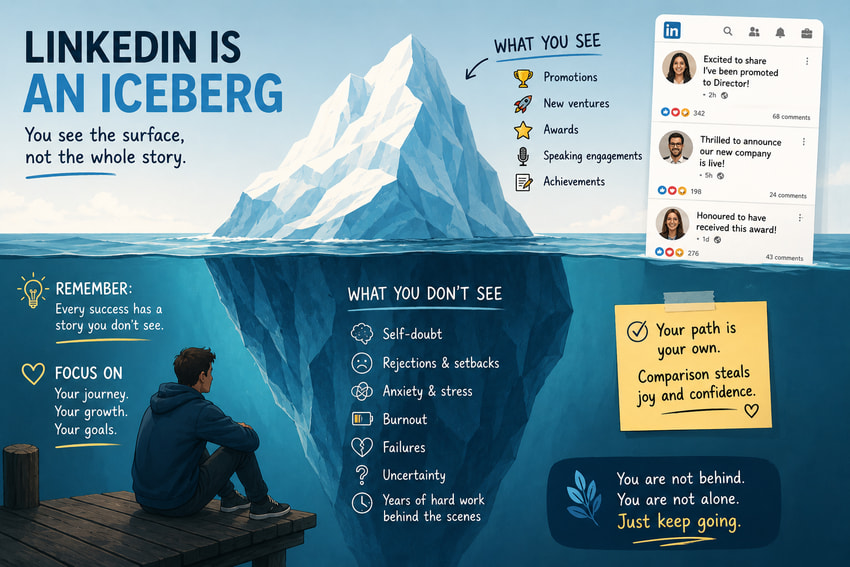
LinkedIn creates the perfect environment for this to happen because it exposes us to a constant stream of professional achievements while providing very little information about the struggles, setbacks, and challenges that occurred behind the scenes.
Why LinkedIn Creates an Unfair Comparison
One of the biggest psychological traps on LinkedIn is that we are comparing our complete reality to somebody else's carefully selected highlights.
Most people do not post about unsuccessful interviews, failed business ventures, rejected applications, workplace stress, burnout, or moments of self-doubt.
Instead, people naturally share promotions, awards, qualifications, new opportunities, and successes.
There is nothing wrong with this. LinkedIn is designed as a professional networking platform, and achievements are often the most relevant content to share.
However, our brains often forget that we are seeing only a small part of the picture.
When we compare our everyday reality to someone else's professional highlights, the comparison is inherently distorted.
The Hidden Role of Envy
Many people feel uncomfortable admitting they experience envy.
Envy is often viewed negatively, leading people to suppress or judge the emotion when it arises.
Psychologically, however, envy is a normal human response.
Envy typically occurs when someone possesses something that we value or desire for ourselves. The feeling is not necessarily about wanting another person to fail. More often, it reflects our own unmet aspirations, goals, or insecurities.
When someone announces a promotion, the discomfort we experience may have less to do with them and more to do with our own concerns about career progression, achievement, or self-worth.
Viewed in this way, envy can sometimes provide valuable information about what matters most to us.
When Success Becomes Tied to Self-Worth
One reason LinkedIn can affect people so strongly is that many individuals unconsciously link achievement with self-worth.
Promotions become evidence of competence.
Recognition becomes evidence of value.
Career progression becomes evidence of personal success.
The difficulty is that self-worth becomes fragile when it depends heavily on external achievements.
Every success story then begins to feel like a personal evaluation. Someone else's promotion can feel like proof that we are falling behind. Another person's business success can feel like evidence that we are not doing enough.
Over time, this mindset creates pressure, anxiety, and chronic dissatisfaction.
The Spotlight Effect
Another psychological process that contributes to LinkedIn anxiety is something known as the spotlight effect.
People often assume that others are paying far more attention to their achievements, failures, and career progress than they actually are.
As a result, individuals may feel they are constantly being evaluated or measured against others.
In reality, most people are primarily focused on their own careers, challenges, and concerns.
Recognising this can help reduce some of the pressure that comparison creates.
Why Comparison Rarely Leads to Satisfaction
Many people assume that comparison will motivate them to work harder and achieve more.
Sometimes it does.
However, psychological research suggests that excessive upward comparison—comparing ourselves to people we perceive as more successful—often leads to reduced wellbeing, lower self-esteem, and increased self-criticism.
The reason is simple.
There will always be someone earning more, achieving more, or progressing more quickly.
If self-worth depends on staying ahead of others, satisfaction becomes almost impossible to achieve.
The finish line continues to move.
Building a Healthier Relationship with LinkedIn
The goal is not to avoid LinkedIn entirely or stop celebrating the success of others.
Instead, it is about developing a healthier perspective.
It can be helpful to remember that every success story contains an invisible history of setbacks, uncertainty, hard work, and challenges that are rarely shared publicly.
It is also important to recognise that career paths are rarely linear. People progress at different speeds and according to different priorities. Success is not a single destination and does not look the same for everyone.
Most importantly, your value as a person is not determined by your job title, salary, or professional achievements.
How Therapy Can Help
For some individuals, professional comparison becomes more than an occasional frustration. It begins affecting confidence, self-esteem, motivation, and mental health.
Therapy can help identify the beliefs that make comparison so powerful. Many people discover that their reactions are connected to perfectionism, imposter syndrome, fear of failure, or long-standing beliefs about achievement and worth.
Evidence-based approaches such as Cognitive Behavioural Therapy (CBT) and Compassion-Focused Therapy (CFT) can help individuals challenge unhelpful thought patterns and develop a more balanced relationship with success.
The goal is not to eliminate ambition. Rather, it is to ensure that confidence and self-worth are not entirely dependent on how we compare ourselves to others.
Seeking Professional Support
If LinkedIn leaves you feeling inadequate, anxious, or constantly behind, you are not alone. Professional comparison has become an increasingly common challenge in a world where we are constantly exposed to the achievements of others.
At The London Psychologist Clinic, we help professionals overcome perfectionism, imposter syndrome, workplace anxiety, and low self-esteem. Therapy can help you develop confidence that comes from within rather than from comparison with others.
Your career is only one part of your identity. Your worth extends far beyond your LinkedIn profile.