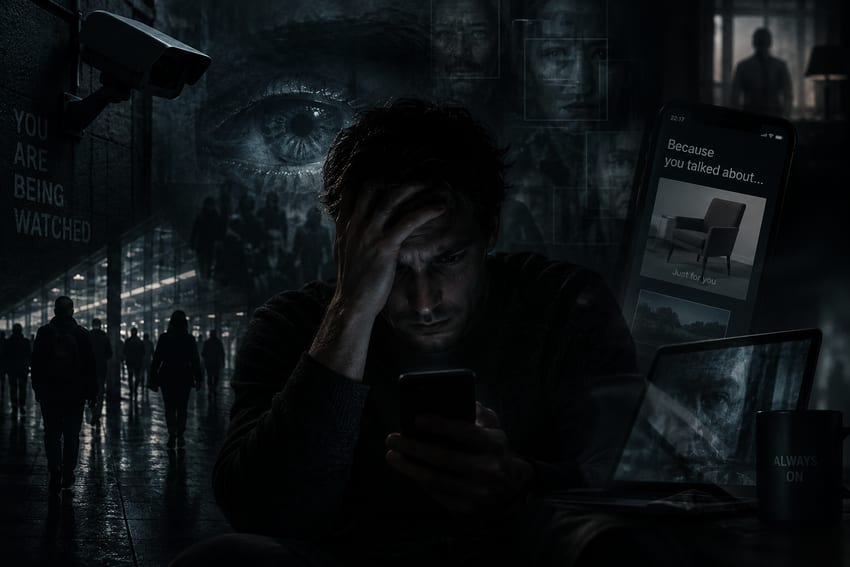


It’s Not Paranoia If It’s True
posted 4th September 2026
“It’s Not Paranoia If It’s True”: Paranoid Ideation in the Age of Smartphones, Tracking and Surveillance
There is an old joke: *“Just because you’re paranoid doesn’t mean they aren’t after you.”* In the digital age, the joke has acquired an uncomfortable relevance.
Most of us now accept things that might have sounded distinctly paranoid thirty years ago. Our location can be recorded by our phones. Websites can track aspects of our behaviour. Supermarket loyalty cards can build remarkably detailed pictures of what we buy. Facial-recognition technology exists. Doorbells contain cameras. Cars record data. Smart televisions and other connected devices can collect information about their users. Online advertising can be based upon known or inferred interests and behaviour.
Then there is an experience familiar to many people. You mention something in conversation – perhaps a holiday in Greece, a new sofa or a particular pair of shoes – and several hours later an advertisement for precisely that thing appears on your phone.
“See. It was listening.”
Was it?
Possibly not in the way we imagine. Advertising systems can make surprisingly accurate predictions from browsing behaviour, previous searches, location, interactions with websites and apps, information inferred about people with similar interests and numerous other signals.
The psychologically interesting part is that *the technology does not have to be secretly listening to every conversation for the resulting experience to feel uncanny*.
And this creates an important question for psychologists.
When does sensible concern about privacy become paranoid ideation?
Paranoia Is Not Simply Being Wrong
One of the misconceptions about paranoia is that a paranoid thought must concern something impossible.
It does not.
A person saying, *“Technology companies collect information about me,” is stating something broadly consistent with reality. A person saying, “There are CCTV cameras in the supermarket,”* may also be perfectly correct.
The psychological issue begins to change when a general possibility becomes a highly personalised conviction.
- *“Companies collect information about customers.”*
can gradually become:
- *“They are specifically monitoring me.”*
and eventually:
- *“The cameras are being used to monitor me personally. The security guard looked at me because he knows about it.”*
The subject matter has not changed dramatically. What has changed is the *interpretation, personalisation, certainty and perceived threat*.
This is one reason paranoia is increasingly understood as existing on a continuum rather than being something experienced exclusively by people with severe mental illness. Research within the general population has found relatively common experiences of mistrust and suspiciousness at one end of this continuum, with much rarer persecutory beliefs at the other.
In one large English study, approximately 18.6% of participants reported feeling that people were against them during the previous year, while considerably fewer endorsed beliefs involving plots to cause them serious harm.
In other words, there may not be a neat psychological border marked *NORMAL THINKING / PARANOIA*.
There are degrees.
The Modern World Provides Paranoia With Plausible Material
This is particularly important clinically.
A century ago, somebody who believed that an invisible device in their pocket knew where they had been, recorded aspects of their behaviour and allowed organisations to predict their interests would have been describing something technologically extraordinary.
Today, they might simply be describing a smartphone.
Modern technology therefore provides unusually fertile material for suspicious thinking because *many of the underlying possibilities are real*.
The question for a clinician should consequently not simply be:
- *“Is surveillance possible?”*
Clearly it is.
More useful questions are:
- *What evidence indicates that this particular individual is being specifically targeted?*
- *How strongly is the belief held?*
- *Can alternative explanations be considered?*
- *How much distress does the belief cause?*
- *How much is the person's behaviour changing because of it?*
That distinction is crucial.
“Everyone Is Watching Me” – A Clinical Example
Consider a fictionalised clinical example based upon themes commonly encountered in psychological practice.
A man in his forties becomes increasingly uncomfortable about his mobile telephone after noticing advertisements related to conversations he remembers having with his wife.
Initially, he changes several privacy settings. This is reasonable enough.
He subsequently covers his phone camera.
Again, many psychologically healthy people do this.
He then begins leaving his telephone outside the room whenever discussing personal matters. He stops using internet banking. He repeatedly checks which applications have microphone permission. He becomes suspicious of his smart television and disconnects it.
Eventually, he starts asking his wife not to discuss family matters inside their home because he believes several electronic devices may be monitoring them.
When she disagrees, this itself becomes evidence:
- *“You don't understand how sophisticated this technology is.”*
He begins examining his router late at night, searching the internet for evidence of surveillance and interpreting unusual advertisements as confirmation that monitoring has occurred.
Something important has happened.
The original privacy concern may have contained a perfectly rational component. But *his life is increasingly being organised around the perceived threat*.
That is often the clinically significant transition.
The Paranoia Trap
Paranoid thinking can become self-reinforcing.
Suppose somebody develops the belief:
- *“My phone is monitoring me.”*
They begin watching carefully for evidence.
The next unusual advertisement becomes highly significant.
“What are the chances of that?”
But hundreds of irrelevant advertisements are forgotten.
This relates to *confirmation bias*: we naturally notice information consistent with an existing belief more readily than information that contradicts it.
Anxiety makes this process stronger.
Once the brain identifies something as potentially threatening, attention becomes biased towards detecting further signs of danger. An ambiguous event that previously meant nothing – a camera moving, an unfamiliar car outside the house, somebody looking at their phone on a train – suddenly becomes potentially significant.
The person becomes more vigilant.
Greater vigilance produces more apparent evidence.
More apparent evidence produces greater anxiety.
Greater anxiety produces still greater vigilance.
A closed psychological loop develops.
Why Checking Can Make Things Worse
An understandable response is to check.
Check the microphone permissions. Check the browser history. Check the router. Check whether the camera light appeared. Search online for reports of similar experiences. Ask somebody else whether they noticed something.
Initially, checking can reduce anxiety.
Unfortunately, repeated reassurance and checking can teach the brain something unintended:
- *“This threat must be important, because I keep checking for it.”*
Avoidance can have a similar effect.
Research into persecutory thinking has identified worry, disrupted sleep, negative beliefs about oneself, reasoning biases and safety-seeking behaviours as factors capable of maintaining paranoid beliefs.
For example, somebody may say:
- *“I haven't been monitored because I stopped carrying my phone.”*
Psychologically, the absence of the feared event is then attributed to the safety behaviour rather than being allowed to challenge the original belief.
This creates an uncomfortable paradox. *The behaviour that makes the person feel safer in the short term may help preserve the fear in the longer term.*
When Should You Become Concerned?
Suspicion becomes more clinically concerning when it becomes *persistent, increasingly certain, personalised and functionally impairing*.
Someone who chooses not to have a smart speaker because they value privacy is not displaying a psychiatric symptom.
Someone who spends four hours every evening investigating whether the smart speaker is transmitting information about them may be experiencing a significant psychological difficulty.
Similarly, covering a webcam is not inherently pathological. Refusing to enter buildings containing cameras because you believe those cameras are specifically identifying and following you is qualitatively different.
Warning signs can include *a growing inability to consider alternative explanations, repeatedly interpreting coincidences as evidence, feeling specifically singled out by organisations or strangers, escalating checking or avoidance, significant sleep disruption, repeatedly seeking reassurance without being reassured, withdrawing from work or social situations, and relationships deteriorating because other people are increasingly incorporated into the suspicious belief system.*
Perhaps the most useful question is simply:
- *“How much of my life is now organised around this belief?”*
If somebody is changing where they go, what they say, whom they trust, where they sleep or how they communicate because of a perceived threat, psychological assessment may be appropriate.
What Does the DSM-5-TR Say?
Paranoid thoughts alone do *not* establish a psychiatric diagnosis.
The *Diagnostic and Statistical Manual of Mental Disorders, Fifth Edition, Text Revision (DSM-5-TR)* describes paranoid phenomena within several different diagnostic contexts.
*Paranoid Personality Disorder* involves a pervasive pattern of distrust and suspiciousness in which the motives of other people may be interpreted as malevolent. Importantly, diagnosis requires considerably more than somebody simply being cautious, private or distrustful of technology.
At a different level of severity, *Delusional Disorder, persecutory type* may involve persistent convictions that somebody is being conspired against, followed, spied upon, harassed or deliberately targeted.
Paranoid and persecutory beliefs may also occur within *psychotic disorders*, alongside some severe mood disorders, or in association with substances or certain medical conditions.
The content of the belief therefore does not by itself determine the diagnosis.
Context, conviction, flexibility, associated symptoms, duration and functional impairment matter enormously.
A competent assessment must also consider whether there is a realistic basis for the person's concerns. Someone who genuinely has been stalked, harassed, monitored by an abusive partner or subjected to another identifiable threat should not have understandable vigilance casually labelled as paranoia.
“But What If I Am Right?”
This is perhaps the most interesting therapeutic question.
Psychological therapy does not require the therapist to respond:
- *“You're wrong. Nobody is monitoring you.”*
That approach can be both unhelpful and clinically simplistic.
A psychologist may instead explore:
- *“What makes you think that?”*
- *“How certain are you – 60%, 90%, 100%?”*
- *“What evidence supports that explanation?”*
- *“Is there evidence that could support another explanation?”*
- *“What would you expect to happen if your interpretation were correct?”*
- *“What happens to your anxiety when you spend an hour checking?”*
And perhaps most importantly:
- *“Even if some degree of digital tracking exists, how much of your life do you want to surrender to worrying about it?”*
This allows uncertainty.
The therapeutic objective is not necessarily to establish absolute certainty that something cannot happen. Absolute certainty is rarely available in ordinary life.
The objective is to develop *a more proportionate relationship with uncertainty*.
Treatment: Learning to Live With Uncertainty
For milder paranoid ideation, *Cognitive Behavioural Therapy (CBT)* can be particularly useful.
Therapy may examine the distinction between *possibility and probability*.
- *“It is technically possible” does not mean “it is probably happening.”*
And:
- *“It happens to some people” does not mean “it is happening specifically to me.”*
Clients can learn to identify catastrophic interpretations, confirmation bias, selective attention to threat and patterns sometimes described as *jumping to conclusions*.
Behavioural experiments may also be useful. These should not become elaborate attempts to prove or disprove a conspiracy. Instead, they can allow the person gradually to reduce safety behaviours and observe what happens.
Reducing excessive checking can be particularly important.
Sleep also deserves attention. Poor sleep can amplify anxiety, emotional reactivity and suspicious thinking, while suspicious thinking itself can interfere with sleep.
Stress, isolation and the use of alcohol or recreational drugs can also complicate the clinical picture.
Where paranoid beliefs form part of psychosis, *specialist psychiatric assessment may be required*. Treatment can include psychological therapy, social interventions and, where clinically appropriate, medication.
A Useful Reality Check
When you find yourself becoming concerned about surveillance, monitoring or another perceived threat, try asking yourself three separate questions:
- *Is my concern possible?*
- *Is there good evidence that it is happening specifically to me?*
- *Is my response proportionate to the actual risk?*
These are very different questions.
It is reasonable to use strong passwords, review app permissions, understand privacy settings and make informed decisions about which connected devices you allow into your home.
It is considerably less helpful to spend several hours every day searching for proof that somebody is watching you.
Good digital privacy involves taking reasonable precautions and then continuing with your life.
Paranoid anxiety demands another check.
And another.
And another.
Perhaps We Are All a Little More Paranoid Now
Technology has complicated the psychology of paranoia because some of the things people fear genuinely happen in some form.
We *are* profiled.
Some of our behaviour *is* tracked.
Cameras *are* widespread.
Algorithms *do* make predictions about us.
Connected devices *can* collect information.
The psychological mistake is not necessarily recognising these realities.
It is moving from:
- *“Technology can collect information about people.”*
to:
- *“Therefore this event proves somebody is deliberately watching me.”*
And then allowing that conclusion to dominate everyday life.
The aim of psychological treatment is therefore not to make somebody naïve or unquestioningly trusting. *Healthy scepticism has value.*
Rather, therapy helps restore *proportion, flexibility and choice*.
You can care about privacy without living in fear of surveillance.
You can recognise that technology collects data without assuming every coincidence has been engineered specifically for you.
And you can accept something psychologically difficult but enormously liberating:
- *Not knowing with absolute certainty is not the same thing as being unsafe.*
If suspicious or paranoid thoughts are beginning to affect your sleep, relationships, work, willingness to leave home or ability to use everyday technology, speaking with a psychologist can help you understand what is maintaining the anxiety and develop strategies for reducing its influence on your life.