


How Thoughts Influence Emotion

posted 29th April 2026
Click to enlarge
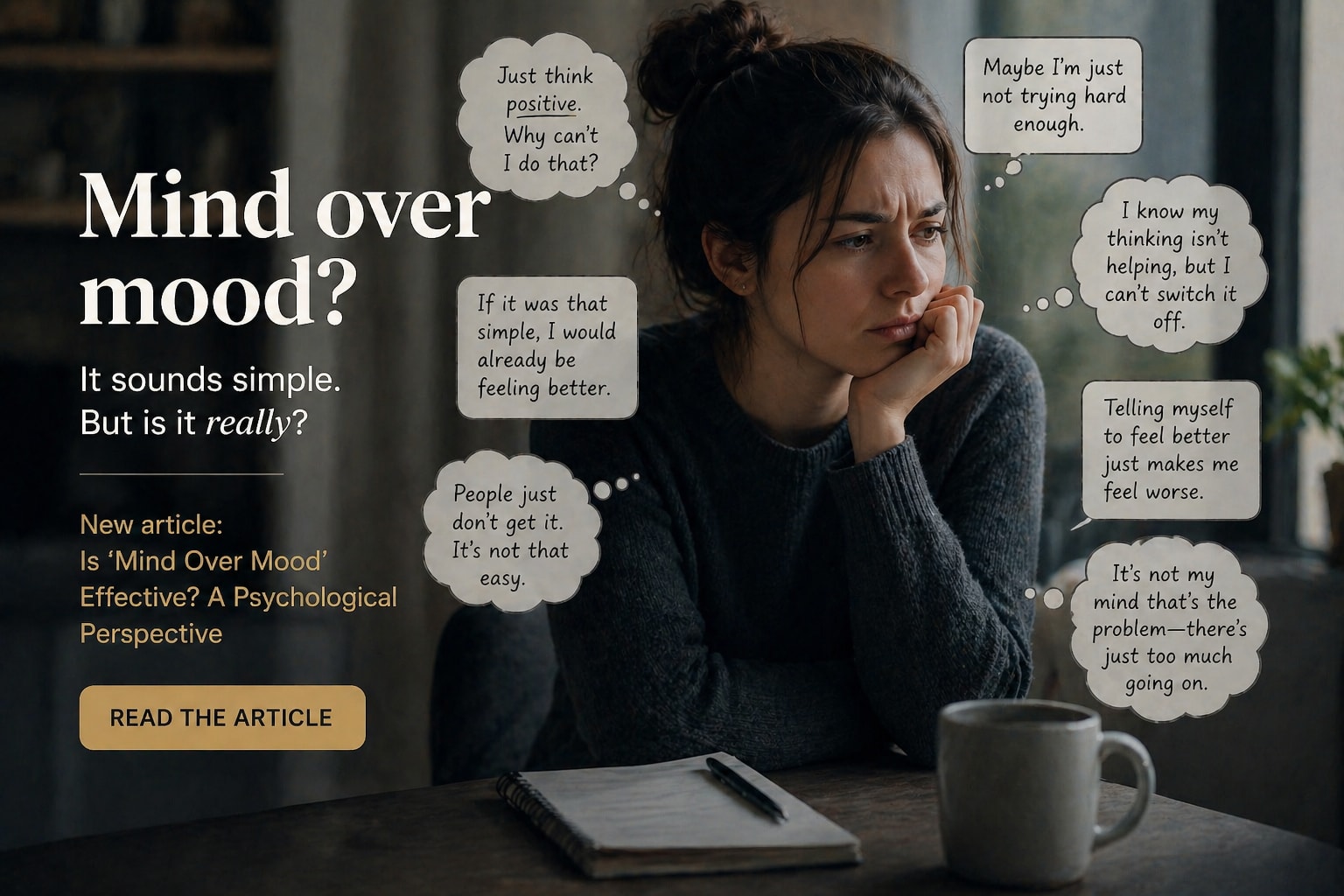
Is “Mind Over Mood” Effective? A Psychological Perspective
Many people are familiar with the idea that changing your thinking can improve how you feel. Phrases such as “it’s all in your mind” or “think differently and you’ll feel better” are often used, but without explanation they can feel overly simplistic or even invalidating. In clinical psychology, however, the relationship between thoughts and emotions is well established and forms the basis of several evidence-based treatments.
The concept commonly referred to as “mind over mood” reflects a core principle within Cognitive Behavioural Therapy (CBT): that how we interpret situations plays a significant role in shaping our emotional responses. This article explores how this process works from a psychological perspective, and when it can be most effective.
Understanding the Link Between Thoughts and Emotions
Emotions do not arise in isolation. They are influenced by how we perceive and interpret events. Two people can experience the same situation but respond very differently depending on their thoughts about it.
For example, a person who interprets a mistake at work as “I’ve failed and everyone will think I’m incompetent” is likely to feel anxious or low. Another person who thinks “that didn’t go as planned, but I can improve” may feel disappointed but not overwhelmed.
In conditions described in the DSM-5-TR, such as depression, anxiety disorders, and health anxiety, patterns of thinking can become biased or unhelpful. These patterns often involve:
- Overestimating threat or danger
- Underestimating one’s ability to cope
- Interpreting ambiguous situations negatively
Over time, these thinking styles can maintain emotional distress.
Cognitive Behavioural Therapy and Thought Patterns
CBT is one of the most widely researched psychological treatments and is recommended in clinical guidelines for a range of conditions. A central component of CBT involves identifying and modifying unhelpful patterns of thinking.
Rather than simply replacing “negative thoughts” with “positive ones,” CBT focuses on developing more balanced and realistic interpretations. This involves examining evidence, considering alternative perspectives, and testing assumptions through experience.
Importantly, thoughts are not treated as facts. They are seen as mental events that can be questioned and evaluated.
How Changing Thoughts Influences Mood
When thinking patterns shift, emotional responses often follow. This is because the brain’s interpretation of a situation directly influences the level of perceived threat or significance.
For instance, if a situation is interpreted as highly threatening, the body’s stress response is activated. If the same situation is viewed as manageable, the physiological and emotional response is reduced.
Over time, repeatedly challenging and modifying unhelpful thoughts can lead to:
- Reduced anxiety
- Improved mood
- Greater emotional stability
This process is gradual and develops through practice rather than immediate change.
The Role of Behaviour in Cognitive Change
While the concept of “mind over mood” emphasises thinking, behaviour plays an equally important role. In practice, cognitive change is often strengthened through action.
When individuals test their beliefs in real-world situations, they gather new evidence. For example, someone who believes “I won’t cope in social situations” may discover, through gradual exposure, that they can manage more effectively than expected.
This interaction between thought and behaviour is central to lasting change. It is not simply about thinking differently, but about experiencing situations in new ways.
Developing Psychological Flexibility
A key aim in therapy is not to eliminate negative thoughts entirely, but to develop flexibility in how they are understood and responded to.
Unhelpful thoughts are a normal part of human experience. Attempting to suppress or eliminate them often has the opposite effect. Instead, learning to recognise thoughts without automatically believing or acting on them can reduce their impact.
This approach is also reflected in therapies such as Acceptance and Commitment Therapy (ACT), which emphasise observing thoughts rather than becoming entangled in them.
A Balanced Perspective
It is important to acknowledge that “mind over mood” does not mean that emotions can be controlled instantly or that distress is purely a matter of thinking differently. Emotional experiences are influenced by a range of factors, including biology, life circumstances, and past experiences.
From a clinical perspective, the concept is best understood as:
>Recognising the influence of thoughts on emotions
>Developing more balanced interpretations
>Supporting these changes through behaviour and experience
When applied in this way, it becomes a practical and evidence-based approach rather than a simplistic idea.
Our thoughts shape how we experience the world, but they are not fixed or unchangeable. By learning to examine and adjust patterns of thinking, it is possible to influence emotional responses in a meaningful and lasting way. Change does not come from forcing positivity, but from developing a more accurate and flexible understanding of situations. Over time, this can lead to improved mood, reduced anxiety, and greater psychological resilience.
If you would like support in applying these principles, our clinicians are experienced in evidence-based approaches including Cognitive Behavioural Therapy and related interventions.