


How Executive Minds Work
posted 16th July 2026
Click image to enlarge
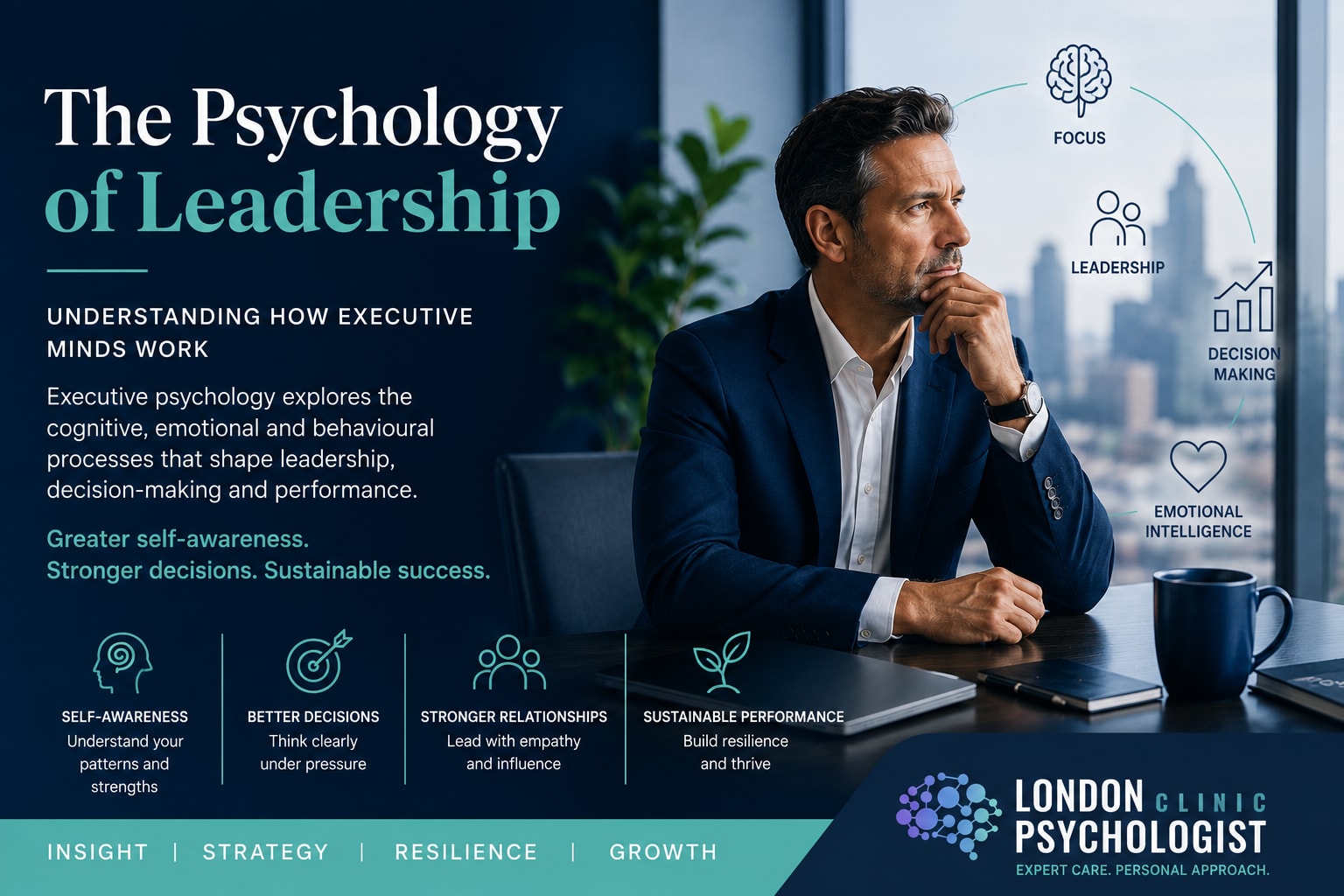
The Psychology of Leadership: Understanding How Executive Minds Work
Why do some leaders remain calm during periods of intense uncertainty while others become overwhelmed? Why do highly intelligent executives sometimes make poor decisions under pressure? And why do successful professionals often struggle to switch off, even when they know it is affecting their health and relationships?
The answers often lie not in business strategy, but in psychology.
Executive psychology is the study of the cognitive, emotional and behavioural processes that influence leadership. It explores how leaders think, make decisions, regulate emotions, manage relationships and respond to stress. While technical expertise and experience are essential, psychological factors frequently determine whether a leader consistently performs at their best or becomes trapped by stress, perfectionism or self-doubt.
Leadership Begins in the Brain
Every executive makes hundreds of decisions each day. Some are routine, while others carry significant financial, organisational or personal consequences. Contrary to popular belief, decision-making is rarely a purely logical process.
Modern neuroscience demonstrates that emotion and cognition work together. Brain regions involved in emotional processing interact constantly with areas responsible for planning, judgement and problem-solving. When these systems are well regulated, leaders can evaluate risk, remain adaptable and think strategically. However, under chronic stress, the brain increasingly prioritises short-term survival over long-term reasoning.
This explains why otherwise capable leaders may become more reactive, less creative and increasingly risk-averse during periods of sustained pressure.
The Hidden Beliefs That Shape Leadership
Every executive develops psychological assumptions about themselves and the world. These beliefs often begin long before an individual enters the boardroom.
Examples include:
"I have to prove myself."
"Mistakes are unacceptable."
"If I am not indispensable, I am replaceable."
"My value depends on achievement."
These underlying beliefs are rarely conscious. They quietly influence how leaders delegate, manage conflict, respond to criticism and cope with setbacks.
For some individuals, these beliefs fuel remarkable ambition and career progression. However, they may also contribute to perfectionism, excessive responsibility, difficulty trusting others and an inability to disconnect from work.
Understanding these psychological drivers is often one of the most valuable aspects of executive therapy.
Personality and Leadership Style
There is no single personality profile that predicts successful leadership.
Some executives are naturally analytical and methodical, while others thrive on innovation, collaboration or rapid decision-making. Effective leadership depends less on personality type itself and more on psychological flexibility—the ability to adapt one's style to changing circumstances.
Highly effective leaders demonstrate strong emotional intelligence, including self-awareness, empathy and emotional regulation. They recognise how their own emotions influence others and can adjust their communication accordingly.
By contrast, leaders who remain unaware of their emotional patterns may unintentionally create anxiety, confusion or conflict within their teams.
Why High Performers Can Become Their Own Biggest Obstacle
Many executives reach senior positions because of behaviours that were rewarded earlier in their careers.
- Working longer hours.
- Accepting every challenge.
- Maintaining exceptionally high standards.
- Taking responsibility for everything.
As organisations grow, however, these same behaviours can become liabilities. Leadership increasingly requires delegation, strategic thinking and trust in others rather than individual performance.
Psychologists often describe this as a developmental transition. Success depends less on doing more and more on thinking differently.
For many executives, this shift is psychologically challenging because it requires letting go of habits that have defined their professional identity for years.
The Psychology of Decision-Making Under Pressure
Executives frequently operate in environments characterised by ambiguity, uncertainty and incomplete information.
Under these conditions, the brain naturally relies on mental shortcuts known as cognitive biases. While these shortcuts allow decisions to be made quickly, they can also distort judgement.
Common examples include confirmation bias, where individuals seek evidence supporting existing beliefs while overlooking contradictory information; availability bias, where recent events appear more significant than they objectively are; and loss aversion, where the fear of losing outweighs the potential benefits of calculated risk.
Developing awareness of these biases enables leaders to pause, reflect and make more balanced decisions.
Emotional Intelligence Is More Than Being Likeable
Emotional intelligence has become one of the most researched predictors of leadership effectiveness.
It involves recognising emotions accurately, understanding how they influence behaviour and responding constructively rather than impulsively.
Leaders with strong emotional intelligence are often better at managing conflict, motivating teams, navigating organisational change and maintaining trust during periods of uncertainty.
Importantly, emotional intelligence is not an innate talent reserved for a select few. Like any psychological skill, it can be developed through reflection, feedback and structured psychological intervention.
How Executive Coaching and Psychological Therapy Differ
Executive coaching and psychological therapy share some similarities but address different aspects of professional development.
Coaching often focuses on achieving specific goals such as improving communication, developing leadership skills or navigating career transitions.
Psychological therapy explores the deeper patterns that influence those goals. It examines emotional regulation, perfectionism, anxiety, confidence, relationship dynamics and longstanding beliefs that may be limiting performance.
For some executives, coaching provides the practical tools they need. For others, unresolved psychological factors continue to undermine progress until they are addressed directly.
The two approaches can complement one another, particularly when psychological wellbeing and organisational performance are considered together.
Building Psychological Resilience
Resilience is frequently misunderstood as simply being able to tolerate greater pressure.
In reality, resilience involves flexibility rather than endurance. It reflects the ability to recover from setbacks, adapt to changing circumstances and maintain perspective during periods of uncertainty.
Psychologists help executives strengthen resilience by developing healthier thinking patterns, improving emotional regulation, enhancing self-awareness and creating sustainable approaches to work.
Rather than becoming tougher, leaders often become more adaptable.
Investing in the Mind Behind the Leader
Organisations routinely invest in strategy, technology and operational performance, yet the psychological health of those responsible for leading these systems is often overlooked.
Executive psychology recognises that sustainable leadership begins with understanding the person behind the role. The way leaders think, interpret events, manage emotions and relate to others influences not only their own wellbeing but also the culture and effectiveness of the organisations they lead.
Working with a psychologist offers a confidential space to examine these patterns, develop greater psychological insight and strengthen the skills that underpin effective leadership. The result is not only improved performance but also a healthier, more sustainable approach to success—one that allows leaders to thrive professionally without sacrificing their wellbeing.