


High Functioning Depression
posted 17th April 2026
High-Functioning Depression”: A Modern Label for an Old Problem
You’ve probably heard someone say, “I think I have high-functioning depression.”
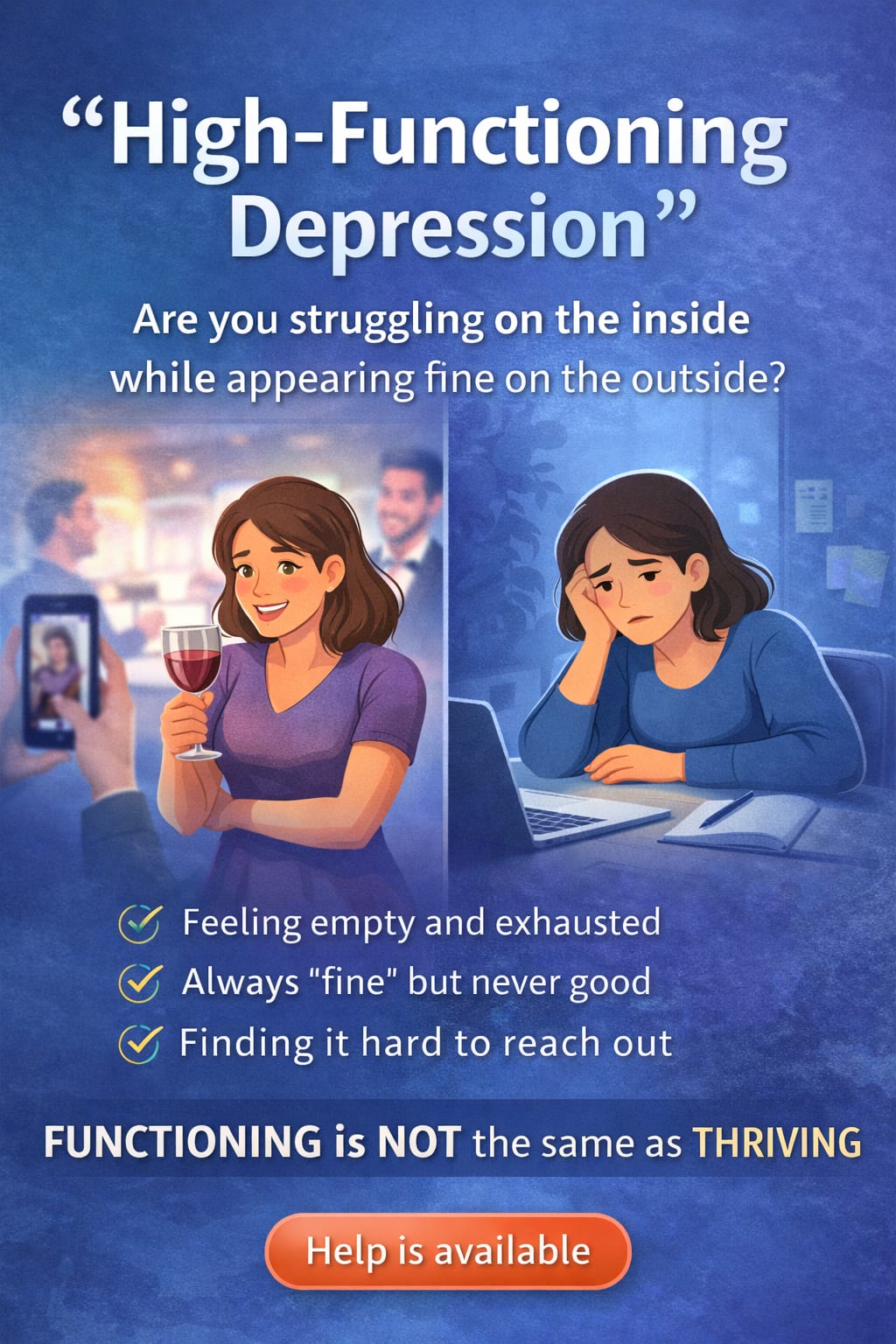
They’re going to work. Seeing friends. Posting on social media. From the outside, everything looks… fine.
But internally, it’s a very different story. The truth is—“high-functioning depression” isn’t a clinical diagnosis. You won’t find it in the DSM-5. But that doesn’t mean it isn’t real. It just means we’re using a popular label to describe something psychology has recognised for a long time.
So what is “high-functioning depression”?
In simple terms, it refers to people who:
- Appear to cope well day-to-day
- Maintain responsibilities (work, school, relationships)
- But experience ongoing low mood, exhaustion, and emotional numbness
They don’t “fall apart”—they keep going, often at a cost.
Clinically, this presentation most closely aligns with:
Persistent Depressive Disorder (Dysthymia) in the DSM-5
Or milder / moderate forms of Major Depressive Disorder (MDD)
The key difference is visibility, not severity.
Why it flies under the radar
Unlike more acute depression, there’s no obvious “crash.”
Instead, it looks like:
- “I’m just tired all the time”
- “I can’t remember the last time I enjoyed anything”
- “I’m functioning… but everything feels flat”
Psychologically, this is often maintained by:
- Behavioural overcompensation (staying busy to avoid feelings)
- Cognitive minimisation (“it’s not bad enough to count”)
- Perfectionism and high standards
In therapy, we often see individuals who have been struggling for years without recognising it as depression.
Where it fits in the DSM-5
Although the term itself isn’t recognised, the symptoms map onto established diagnoses:
- Persistent Depressive Disorder (PDD)
- Low mood most days for at least 2 years
- Accompanied by fatigue, low self-esteem, poor concentration
- Often described as a “baseline” of low mood
- Major Depressive Disorder (MDD)
- More episodic
- Includes significant impairment—but not always visible externally
So “high-functioning depression” is better understood as:
A descriptive, non-clinical label for individuals meeting criteria for depressive disorders while maintaining outward functioning.
The psychological cost of “functioning”
This is where it becomes clinically important.
People with this presentation often:
- Delay seeking help (“others have it worse”)
- Normalise their symptoms
- Burn out suddenly after long periods of coping
From a cognitive perspective, there’s often:
- All-or-nothing thinking (“if I’m still working, I can’t be depressed”)
- Emotional suppression
- A disconnect between external performance and internal experience
In other words, functioning becomes a mask.
Treatment – and why it works well
The positive side? This is highly treatable.
Evidence-based approaches include:
- Cognitive Behavioural Therapy (CBT) – addressing negative thinking patterns
- Behavioural Activation (BA) – reintroducing meaningful activity
- Schema Therapy – particularly where long-term patterns exist
Because individuals are still functioning, engagement with therapy is often strong, and outcomes can be very good.
Many clients report:
- Improved emotional awareness
- Reduced burnout
- A shift from “surviving” to actually experiencing life again
- Why this label has become popular
There’s a reason “high-functioning depression” is everywhere right now. It reflects a broader cultural shift:
- Greater awareness of mental health
- Recognition that distress doesn’t always look dramatic
- Increasing pressure to perform, even when struggling
It’s a term that helps people say:
“I’m not okay—but I’m still managing.”
And sometimes, that’s the hardest place to be.
“High-functioning depression” may not be in the DSM-5—but the experience behind it absolutely is. As psychologists, the goal isn’t to label it perfectly—it’s to recognise it early, understand it properly, and treat it effectively. Because functioning isn’t the same as thriving.
Click to enlarge