


High-Functioning Anxiety

posted 8th May 2026
High-Functioning Anxiety: When Success Hides Psychological Distress
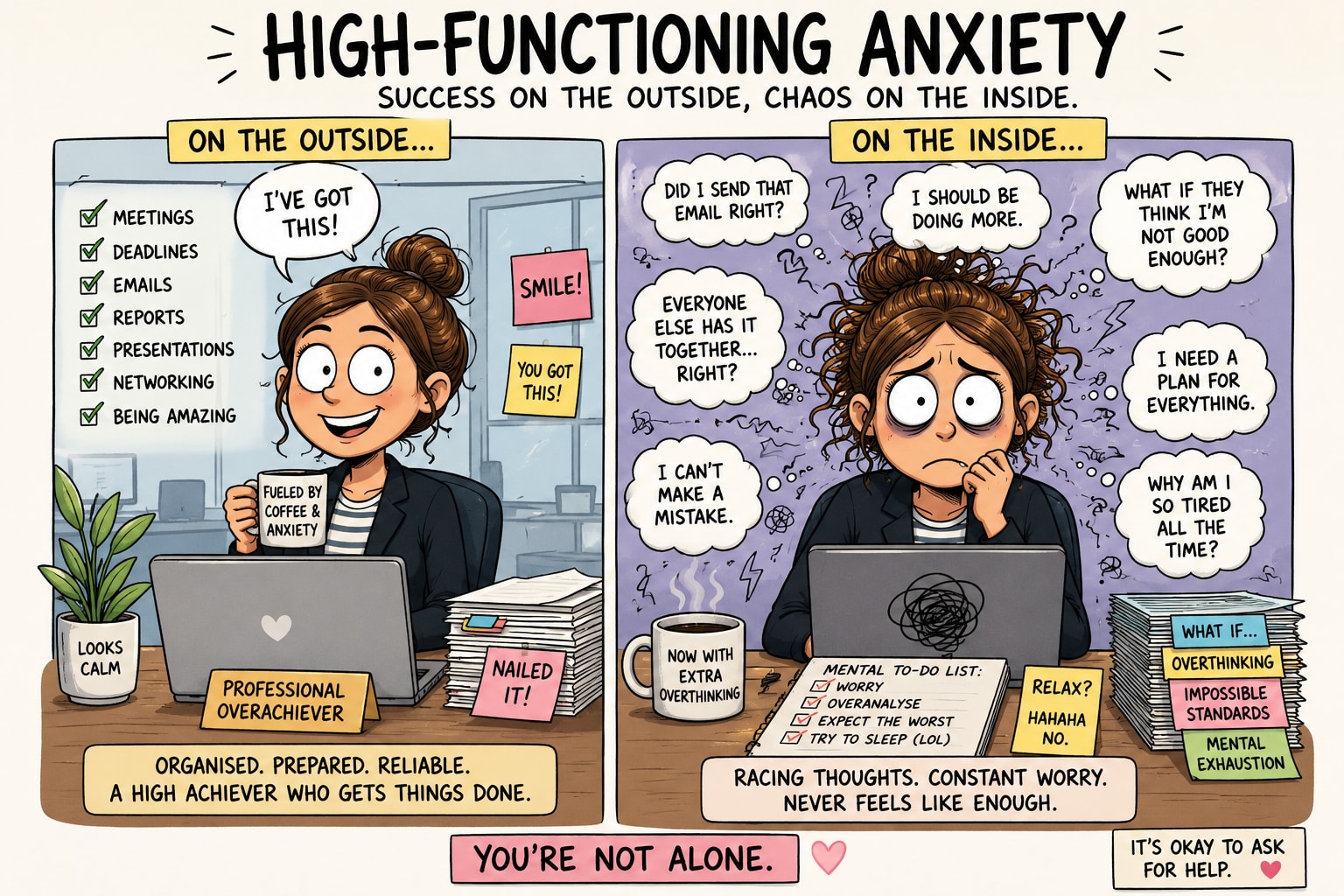
Anxiety is often imagined as something visibly disruptive — panic attacks, emotional overwhelm, avoidance, or an inability to cope with daily life. In reality, many people experiencing significant anxiety continue functioning at a very high level professionally, academically, and socially. They attend meetings, meet deadlines, care for families, maintain responsibilities, and appear outwardly successful, while internally struggling with chronic worry, tension, self-criticism, and exhaustion.
This is sometimes informally referred to as “high-functioning anxiety.” Although the term itself is not a formal diagnosis within the Diagnostic and Statistical Manual of Mental Disorders, Fifth Edition (DSM-5), the experiences associated with it are highly recognised within clinical psychology and may overlap with conditions such as Generalised Anxiety Disorder (GAD), social anxiety, perfectionism-related difficulties, obsessive thinking, or chronic stress responses.
One reason high-functioning anxiety can go unnoticed is because anxious behaviours are often socially rewarded. Perfectionism, over-preparation, hyper-productivity, constant availability, and excessive conscientiousness may initially appear positive in professional environments. Individuals with high levels of anxiety are often described as driven, organised, reliable, or highly motivated. Colleagues may admire their work ethic without recognising the emotional cost behind it.
Internally, however, the experience can be very different.
Many individuals with chronic anxiety describe feeling unable to truly relax, even during rest. Thoughts may remain constantly active — replaying conversations, anticipating mistakes, analysing social interactions, or mentally preparing for worst-case scenarios. Some experience persistent physical tension, headaches, sleep disruption, digestive issues, irritability, or emotional exhaustion despite continuing to function outwardly.
A common feature is the belief that slowing down will lead to failure, criticism, or loss of control. Productivity can become psychologically tied to self-worth. Achievements may provide only temporary relief before anxiety quickly shifts onto the next task, responsibility, or perceived risk.
From a psychological perspective, anxiety is not simply “overthinking.” It involves activation of threat-detection systems within the brain and body. For individuals prone to chronic anxiety, the nervous system may remain in a near-constant state of hypervigilance, even in relatively safe environments. This can create a pattern where the body struggles to fully switch out of stress mode.
Over time, this sustained physiological activation may contribute to:
- fatigue
- insomnia
- concentration difficulties
- muscle tension
- lowered mood
- emotional burnout
- panic symptoms
- reduced resilience to stress
Importantly, many people with high-functioning anxiety become skilled at masking distress. They may minimise symptoms, avoid discussing emotional difficulties, or fear appearing weak or incapable. Some individuals do not realise how anxious they are because living in a heightened state of internal pressure has become normalised over many years.
Perfectionism also commonly plays a role. In psychology, perfectionism is not simply having high standards. Maladaptive perfectionism often involves intense fear of mistakes, excessive self-criticism, rigid expectations, and difficulty tolerating uncertainty or imperfection. Success may feel less like satisfaction and more like temporary avoidance of failure.
Modern workplace culture can unintentionally reinforce these patterns. Constant connectivity, performance pressure, comparison culture, and blurred boundaries between work and personal life may all contribute to chronic psychological strain. Many professionals continue operating under high stress for prolonged periods before recognising the impact on mental health.
One of the challenges with high-functioning anxiety is that people often seek support only once functioning begins to deteriorate significantly. Yet psychology consistently shows that earlier intervention is associated with better long-term outcomes.
Therapy can help individuals understand the cognitive, behavioural, and emotional patterns maintaining anxiety. Psychological work may involve developing healthier boundaries, addressing perfectionism, improving emotional regulation, increasing tolerance of uncertainty, and reducing reliance on overachievement as a coping mechanism.
Importantly, reducing anxiety does not mean removing ambition, motivation, or competence. Many people fear that if they become “less anxious,” they will lose their edge professionally. In reality, chronic anxiety often reduces creativity, flexibility, emotional wellbeing, and sustainable performance over time.
Healthy functioning is not the absence of responsibility or ambition — it is the ability to function effectively without remaining in a constant state of internal threat.
Psychology increasingly recognises that many highly capable individuals are silently struggling beneath outward success. Anxiety does not always look like dysfunction. Sometimes it looks like overworking, overthinking, overperforming, and carrying invisible levels of psychological pressure while appearing completely “fine” to everyone else.
Click image to enlarge