


Health Anxiety Treatment
posted 24th April 2026
Click to enlarge
Health Anxiety (Illness Anxiety Disorder): Understanding the Fear of Being Unwell and How CBT Can Help
Health Anxiety, sometimes referred to as Illness Anxiety Disorder, is a condition where individuals experience persistent worry about their health, often fearing that they have or will develop a serious illness. At The London Psychologist Clinic, we frequently see clients who are caught in a cycle of checking symptoms, seeking reassurance, and feeling temporarily relieved—only for the anxiety to return again. This can be exhausting, time-consuming, and deeply distressing.
According to the DSM-5, Illness Anxiety Disorder is characterised by a preoccupation with having or acquiring a serious illness, despite medical reassurance and minimal or no physical symptoms. Individuals may frequently check their body for signs of illness, search online for diagnoses, or repeatedly seek reassurance from doctors, friends, or family. While these behaviours are understandable, they often maintain the anxiety rather than resolve it.
Health anxiety exists on a spectrum, and many people experience it to some degree—particularly following illness, stress, or exposure to health-related information. However, when the worry becomes persistent and begins to interfere with daily life, it may indicate a more significant difficulty. The core issue is not the presence of physical sensations themselves, but how they are interpreted. Normal bodily sensations—such as a headache, a change in heartbeat, or fatigue—can be misinterpreted as signs of serious illness.
The causes of health anxiety are multifaceted. Psychologically, individuals may have a heightened sensitivity to bodily sensations and a tendency to interpret them in a catastrophic way. Beliefs such as “If I don’t check, something could be missed” or “I won’t be able to cope if I become ill” play a key role. Early experiences, such as exposure to illness in the family or receiving strong messages about health, can also shape these patterns. In addition, the modern environment—particularly access to vast amounts of online health information—can amplify anxiety and reinforce unhelpful thinking.
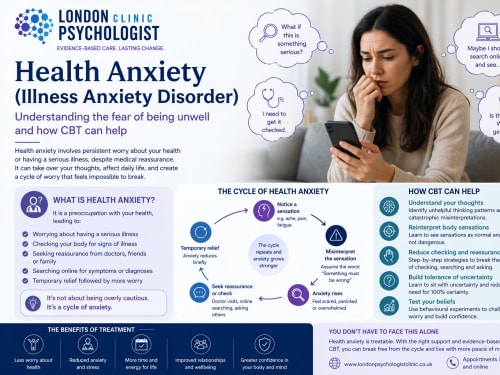
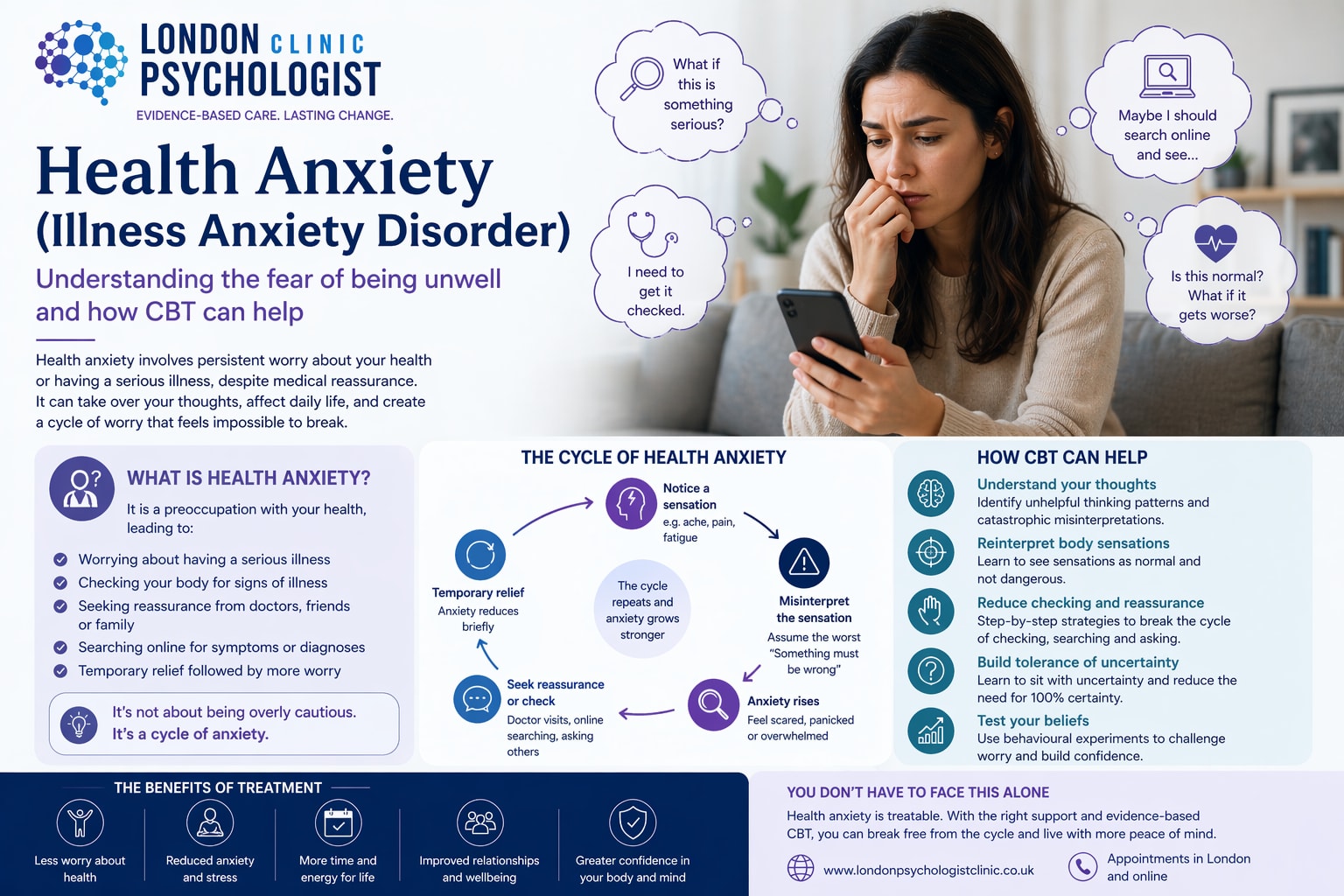
A central maintaining factor in health anxiety is the cycle of reassurance and checking. For example, noticing a physical sensation may trigger worry, leading to online searches or medical reassurance. While this may reduce anxiety temporarily, it reinforces the belief that the threat was real, making the anxiety more likely to return. Over time, this creates a self-perpetuating loop that becomes increasingly difficult to break.
The encouraging news is that health anxiety is highly treatable. Cognitive Behavioural Therapy (CBT) is the most effective and widely recommended psychological treatment for this condition. CBT helps individuals understand the patterns that maintain their anxiety and develop new ways of responding to uncertainty and physical sensations.
One of the key elements of CBT for health anxiety is learning to reinterpret bodily sensations more accurately. Rather than immediately assuming the worst, individuals are supported to consider alternative, more realistic explanations. This helps reduce the intensity of anxiety and breaks the automatic link between sensation and fear.
CBT also focuses on reducing reassurance-seeking and checking behaviours. While these behaviours feel protective, they actually maintain anxiety over time. Gradually reducing them allows individuals to learn that anxiety can decrease naturally without constant checking, and that feared outcomes often do not occur.
Another important component is building tolerance of uncertainty. Health anxiety is often driven by a desire for complete certainty about one’s health—something that is not realistically achievable. Therapy helps individuals become more comfortable with uncertainty, reducing the need for constant reassurance.
Behavioural experiments are also used to test beliefs in real-life situations. For example, a client might reduce symptom checking for a period of time and observe what happens. These experiences provide powerful evidence that challenges anxious predictions and builds confidence.
Research consistently shows that CBT is highly effective for health anxiety, leading to significant reductions in worry and improved quality of life. Importantly, the skills learned in therapy can be applied long-term, helping individuals maintain progress and manage future challenges.
Health anxiety can feel isolating, particularly when others struggle to understand the intensity of the fear. However, it is a recognised and treatable condition—not a sign of weakness or overreaction. With the right support, it is entirely possible to break free from the cycle of worry and develop a more balanced and confident relationship with your health.
At The London Psychologist Clinic, we specialise in evidence-based treatments tailored to each individual. Our approach is designed not only to reduce symptoms, but to create lasting change—helping you move from constant worry to a greater sense of calm, control, and wellbeing.