


Generalised Anxiety Disorder vs. Panic Disorder
posted 17th April 2026
Generalised Anxiety Disorder vs. Panic Disorder: A Clinical Comparison
Generalised Anxiety Disorder (GAD) and Panic Disorder are both classified within the anxiety disorders in the Diagnostic and Statistical Manual of Mental Disorders, Fifth Edition (DSM-5), and while they share overlapping features—most notably heightened physiological arousal and excessive fear—they differ significantly in their presentation, underlying mechanisms, and treatment focus.
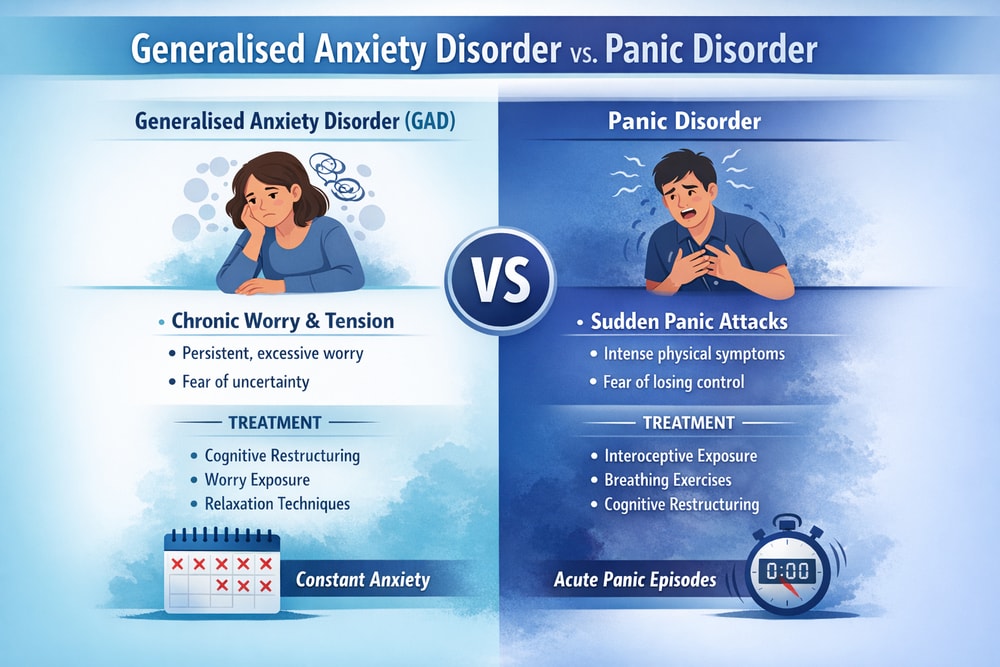
Generalised Anxiety Disorder (GAD) is characterised by persistent and excessive worry about a range of everyday situations (e.g., health, work, relationships), occurring more days than not for at least six months. The worry is experienced as difficult to control and is accompanied by symptoms such as restlessness, muscle tension, irritability, sleep disturbance, and difficulties with concentration. From a psychological standpoint, GAD is often conceptualised as a disorder of intolerance of uncertainty, where individuals engage in chronic worry as a maladaptive attempt to anticipate and prepare for potential threats. Cognitive models highlight verbal-linguistic worry processes, which paradoxically maintain anxiety by preventing emotional processing.
In contrast, Panic Disorder is defined by the presence of recurrent, unexpected panic attacks—sudden surges of intense fear or discomfort that reach a peak within minutes. These episodes are accompanied by acute physical symptoms such as palpitations, shortness of breath, dizziness, chest pain, and a sense of impending doom or loss of control. Crucially, the diagnosis also requires persistent concern about future attacks or significant behavioural changes (e.g., avoidance of certain places or activities). Psychologically, Panic Disorder is understood through models of catastrophic misinterpretation of bodily sensations, where normal physiological changes (e.g., increased heart rate) are interpreted as dangerous (e.g., “I’m having a heart attack”), thereby triggering a feedback loop of escalating anxiety.
Although both disorders involve anxiety, the temporal pattern distinguishes them. GAD presents as a chronic, diffuse state of apprehension, whereas Panic Disorder is episodic and acute, with intense bursts of fear separated by periods of relative calm. This distinction is clinically important, as it informs treatment.
Psychological treatment for both conditions is typically grounded in Cognitive Behavioural Therapy (CBT), but the techniques differ in emphasis.
For GAD, treatment focuses on:
- Cognitive restructuring of worry-based thoughts
- Reducing avoidance of uncertainty
- Worry exposure and tolerance building
For Panic Disorder, CBT prioritises:
Interoceptive exposure (deliberately inducing feared bodily sensations)
Reattribution of physical symptoms
Elimination of safety behaviours
Treatment duration for both disorders is often 8–16 sessions, although outcomes can vary depending on severity and comorbidity. Prognosis is generally favourable, with many individuals experiencing substantial symptom reduction. However, GAD may show more residual cognitive symptoms, whereas Panic Disorder often demonstrates rapid improvement when exposure-based techniques are effectively implemented.
In summary, while GAD and Panic Disorder both involve heightened anxiety, GAD is best understood as a persistent cognitive-emotional state driven by worry and intolerance of uncertainty, whereas Panic Disorder is an acute fear-based condition rooted in the misinterpretation of physiological sensations. Differentiating between the two allows for more targeted and effective psychological intervention.