


Family Estrangement Complexity
posted 24th February 2026
The Complicated Background Behind Family Estrangement
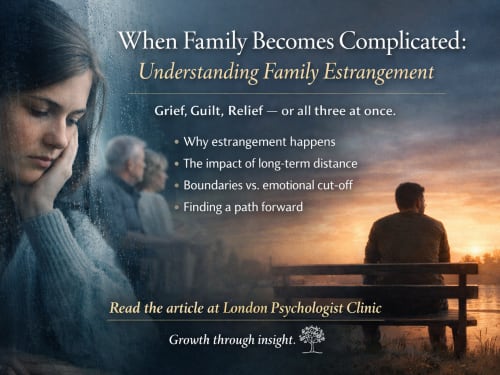
Family estrangement—the gradual drifting apart or abrupt cutting off of contact between close relatives—is one of the quiet heartbreaks we rarely talk about, even though it touches many lives. Research suggests that around 8 % of adults in the UK say they are personally estranged from a family member, and more than a quarter know someone who is. In the United States, a similar pattern appears, with about 27 % of adults reporting some form of estrangement from at least one family member.
When you live it, estrangement rarely feels like a clean decision. For many people it’s a slow, painful process of trying and failing to be heard, or an impulsive reaction to a particularly damaging incident. One of the hardest things about estrangement is that both sides can feel deeply hurt, albeit in very different ways. Adult children may experience relief that a cycle of hurt has stopped, but also profound grief for what’s been lost, especially at holidays or family milestones. Parents can feel bewildered and devastated, often replaying every memory and wondering where exactly things went wrong. There isn’t one story; there are overlapping layers of love, disappointment, duty, and identity all tangled together.
Some estrangements stem from what any therapist would recognise as harmful patterns, where emotional abuse, neglect, or betrayal has left deep wounds. Persistent criticism, belittling of achievements, ignoring emotional needs, or actively undermining someone’s life can accumulate into a sense of being unsafe or devalued. For example, adults who grew up with parents who dismissed their feelings, controlled their choices, or minimised their struggles can eventually feel they have nothing left to give—and nothing left to gain from contact. Research shows that clashes of personality and values, mismatched expectations about relationships, and long-standing emotional abuse are often central to the breakdown of adult family relationships.
Substance misuse is another frequent backdrop to estrangement. When addiction shapes family life, cycles of chaos and broken promises can wear down even the most determined bonds. A parent who drinks heavily might miss important events, lash out unpredictably, or fail to keep their word; a sibling battling addiction might bring danger or instability into the home. In some cases, cutting contact is an attempt not to punish, but simply to survive emotionally and physically. At the same time, addiction is often rooted in personal trauma—sometimes connected to experiences within the very family relationships that estranged relatives are trying to escape—so these stories are rarely simple black-and-white narratives.
Estrangement also occurs in families that, to outsiders, seem to have nothing “obviously” wrong with them. Some parents, especially those who are intensely involved or have rigid expectations, find it hard to let adult children make autonomous choices. When that parenting style continues into adulthood, it can feel controlling or dismissive to the child, eroding their sense of self and autonomy. An adult child who wants to live differently—whether in terms of career, relationships, lifestyle, or identity—may find themselves at odds with parents who cannot move beyond their own expectations or fears. In other cases, siblings who clashed over decades of comparison, rivalry, or differential treatment find that distance feels safer than constant conflict. These incompatibilities can be so persistent that, even with love on both sides, the relationship no longer feels workable.
Clinically, family estrangement isn’t a diagnosable condition in the DSM-5, but it intersects with recognised relationship problems that can affect mental health. The DSM-5 includes codes for Parent–Child Relational Problems and Sibling Relational Problems, acknowledging that persistent conflict, boundary violations, and communication breakdowns within families can be significant stressors on wellbeing. These codes allow clinicians to focus on the relational dynamics that contribute to anxiety, depression, or trauma symptoms, even if estrangement itself isn’t a “disorder.”
What keeps estrangement going often isn’t a single unresolved dispute, but a pattern of failed attempts to change or repair how the relationship works. Endless arguments about past events can harden into stories that protect each person’s view of themselves—“I was always trying to help” versus “I was continually hurt.” Shame and stigma make it harder to talk about these issues; people often feel judged for “abandoning” their family or, conversely, for “refusing to tolerate abuse.” Many estranged people describe feeling like outsiders in a world that still assumes family ties are always unconditionally supportive.
At its most honest, estrangement can feel like living with two conflicting truths. For some people, no contact brings a sense of peace after years of emotional turmoil—freedom from constant criticism or chaos. For others, the absence of family brings loneliness, a loss of identity, and complicated grief that doesn’t neatly resolve because the person is still alive and part of your shared history. Holidays, birthdays, and life events can reopen old wounds and remind you of what you’ve given up in pursuit of safety or self-respect.
Sometimes estrangement becomes cyclical, with periods of contact followed by renewed distance, especially when old patterns resurface or expectations collide. This may be most common between adult children and mothers, many of whom oscillate between connection and estrangement as new conflicts arise or boundaries are tested.
There is no universal answer to whether estrangement is “better” or “worse” for everyone involved. In families where there is ongoing harm—whether through repeated criticism, emotional manipulation, or neglect—distance can be necessary for someone’s mental health and sense of self. Accepting that a relationship may never function as either party hopes can itself be an act of compassion, even if it hurts. In other families, estrangement becomes a long-term wound that isolates people, leaving all involved to grieve not just what was lost, but what they hoped the relationship could be.
At The London Psychologist Clinic, we approach estrangement with empathy—not judgement. We recognise that behind every estranged relationship is a human story marked by love and pain, hope and disappointment. Some families find ways back to each other through therapy, clearer boundaries, and accountable conversations; others find peace in honouring the separation while continuing their own personal growth. What matters most is not forcing a particular outcome, but understanding the emotional truths of each person involved, validating their experience, and supporting their wellbeing as they navigate one of life’s most difficult relational challenges.