


Explore depersonalisation and derealisation
posted 21st August 2026
Depersonalisation and Derealisation: When You Suddenly Don't Feel Like Yourself
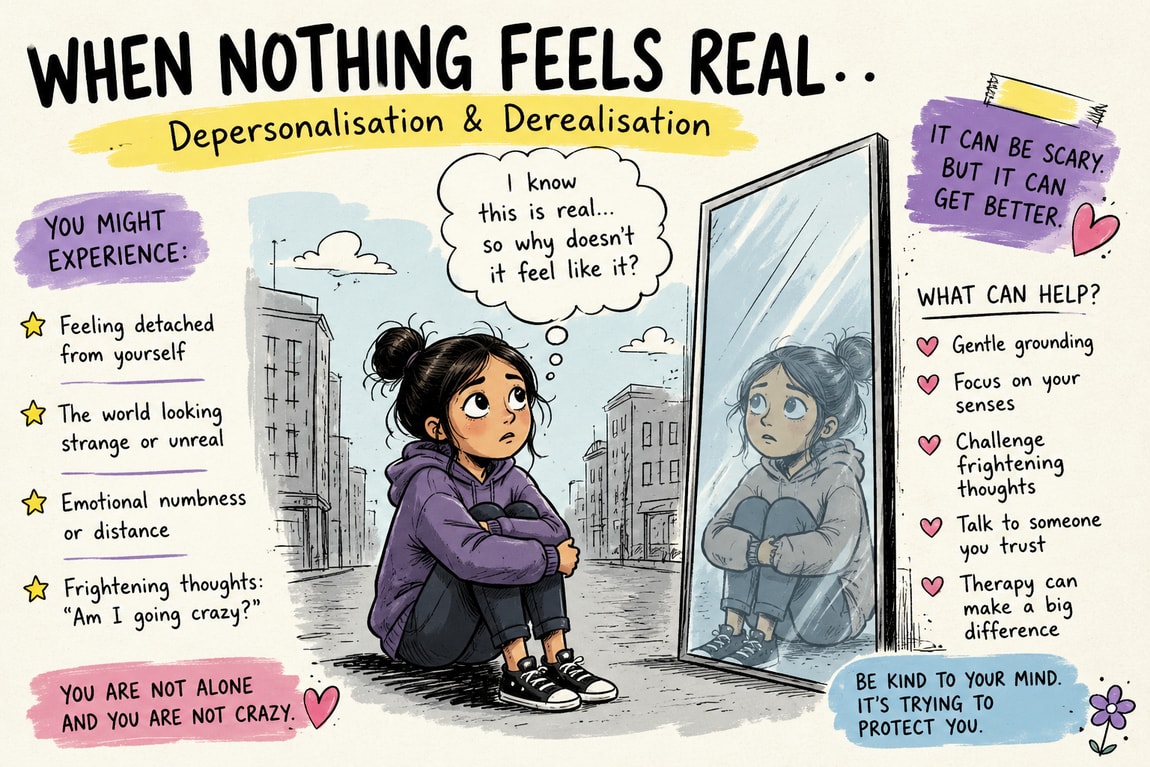
Imagine looking in the mirror and recognising the person staring back at you, but somehow feeling as though the reflection is not quite you.
Or walking down a familiar street and suddenly feeling that everything around you looks strangely artificial, distant or dreamlike.
You know where you are. You know logically that the world is real. Yet something feels profoundly different.
These experiences are known as *depersonalisation and derealisation*. They can be frightening, particularly when someone has never experienced them before. What makes them especially unsettling is that the person is often completely aware of how strange the experience feels.
What Is Depersonalisation?
Depersonalisation describes a feeling of detachment from yourself.
People describe it in different ways. Some feel as though they are observing themselves from outside their body. Others describe functioning on "autopilot", feeling emotionally numb or experiencing their thoughts and actions as strangely distant.
A person might continue going to work, talking to friends, driving or shopping while internally thinking:
"Why don't I feel like myself?"
This discrepancy can be deeply disturbing because everything may appear normal to everybody else.
What Is Derealisation?
Derealisation involves a sense of detachment from the world around you rather than from yourself.
Familiar places can suddenly appear unfamiliar. Colours, sounds, distances or lighting may seem subtly different. People sometimes describe the world as looking flat, artificial, foggy or as though they are watching events through a screen.
A particularly important feature is that people experiencing derealisation generally retain *reality testing*.
Someone might say:
"It feels as though the world isn't real, but I know that it is."
That distinction is psychologically and clinically important.
Why Would the Brain Do Something So Strange?
One way of understanding depersonalisation is as an extreme form of psychological distancing.
When the nervous system becomes overwhelmed by anxiety, stress, fear or emotional overload, detachment may function as a protective response.
Instead of experiencing everything at full emotional intensity, the mind appears to create distance from the experience.
In the short term, this can make psychological sense.
If something feels overwhelming, emotional detachment reduces its intensity.
The problem begins when the sensation itself becomes frightening.
The First Experience Can Be Terrifying
For many people, the first significant episode is the most frightening because they have no explanation for what is happening.
Someone might be sitting on a train, studying, working or walking through a supermarket when suddenly everything feels different.
They may immediately think:
"Am I losing my mind?"
"What if I never feel normal again?"
"What is happening to my brain?"
Those thoughts understandably create anxiety.
But increased anxiety can intensify the sensations of unreality.
A cycle can then begin.
The Anxiety–Depersonalisation Cycle
Imagine someone experiences derealisation during a period of exhaustion and anxiety.
They notice the sensation and become frightened.
The fear increases physiological arousal.
Greater arousal makes them feel even more detached.
They then begin monitoring themselves.
"Do I feel normal now?"
"Does the room still look strange?"
"Do I feel real?"
This constant internal checking directs even more attention towards the experience.
The person may eventually spend much of the day checking whether the sensation has disappeared.
Ironically, the attempt to make the experience go away can help keep it at the centre of attention.
Why Looking in the Mirror Can Sometimes Feel Strange
Some people experiencing depersonalisation become particularly uncomfortable when looking at themselves.
Normally, we do not analyse the experience of recognising our own face. It happens automatically.
But once someone becomes intensely self-focused, processes that are usually unconscious can suddenly become objects of scrutiny.
They might stare at their reflection thinking:
"Why does that feel like me?"
The more they examine the sensation, the stranger it can become.
A similar phenomenon can happen with someone's own voice, thoughts or movements.
Ordinary experiences become unfamiliar because they are being consciously examined in a way they normally are not.
Can Anxiety Cause Depersonalisation?
Depersonalisation and derealisation can occur in association with intense anxiety and panic.
During a panic attack, the nervous system is highly activated. Heart rate increases, breathing changes and attention becomes strongly focused on potential danger.
Some people experience dizziness or visual changes alongside feelings of unreality.
The experience can then become incorporated into the person's fear of panic.
Instead of simply fearing a racing heart, they begin fearing the detached sensation itself.
They may avoid situations where it previously occurred, such as crowded shops, trains, lectures or social environments.
Over time, the fear of experiencing depersonalisation can become more disruptive than the original sensation.
The Difference Between an Experience and a Disorder
Brief experiences of depersonalisation or derealisation are not necessarily evidence of a psychiatric disorder.
Transient experiences can occur during severe stress, exhaustion, panic or other circumstances.
*Depersonalisation/Derealisation Disorder*, however, is a recognised condition in which persistent or recurrent experiences of depersonalisation, derealisation or both cause significant distress or interfere with functioning.
Assessment is important because similar experiences can occur in different psychological, medical or substance-related contexts.
A clinician therefore considers the broader picture rather than diagnosing someone simply because they occasionally feel detached.
Why Constant Googling Can Make Things Worse
Someone frightened by an unfamiliar psychological sensation understandably wants an explanation.
The internet provides thousands.
Unfortunately, repeatedly searching symptoms can increase anxiety rather than resolve it.
A person may read one reassuring explanation followed immediately by something alarming.
They then search again for reassurance.
For a few minutes they feel calmer.
Then another doubt appears.
"But what if mine is different?"
Another search begins.
This resembles other reassurance cycles seen in anxiety. The relief produced by checking is temporary, which teaches the brain to seek reassurance again the next time uncertainty appears.
Why Trying to Feel 'Normal' Can Become a Trap
People experiencing depersonalisation often become intensely focused on recovering a particular internal sensation.
They remember how they felt before and continually compare the present moment with it.
"Do I feel like myself yet?"
The difficulty is that most people do not normally monitor whether they "feel real".
The very act of checking makes the experience unusually self-conscious.
It is similar to thinking about how naturally you are breathing.
Breathing usually occurs automatically. The moment you monitor every breath, it can begin to feel strangely unnatural.
Sometimes recovery therefore involves *reducing the struggle with the sensation rather than constantly testing whether it has disappeared*.
Grounding and Returning Attention to the Outside World
When someone feels detached, there can be a strong temptation to retreat further inside their own thoughts.
Grounding techniques attempt to reverse this by deliberately directing attention towards immediate sensory information.
This might involve noticing the physical sensation of feet against the floor, identifying sounds in the room, holding something cold, describing objects in the environment or becoming absorbed in an ordinary activity.
The purpose is not necessarily to force the sensation away.
It is to reduce the constant internal monitoring that can maintain anxiety around it.
Continuing ordinary routines can also be important. Avoiding life until you "feel completely normal again" can unintentionally teach the brain that the sensation represents danger.
The Fear of the Feeling Is Often Crucial
One of the most useful psychological distinctions is between the original sensation and the interpretation placed upon it.
Feeling temporarily detached is uncomfortable.
Thinking:
"This means I'm permanently losing control"
is considerably more frightening.
Therapy can therefore examine catastrophic interpretations surrounding the experience.
What does the person believe the sensation means?
What are they afraid will happen?
How often are they checking?
What situations have they begun avoiding?
These questions can reveal a cycle that initially seemed mysterious.
Psychological Therapy for Depersonalisation and Derealisation
Psychological treatment depends upon the individual and the circumstances surrounding their symptoms.
*Cognitive Behavioural Therapy (CBT)* may help someone recognise catastrophic interpretations, reduce excessive symptom monitoring and address anxiety and avoidance behaviours that are maintaining distress.
Where experiences are connected with trauma, chronic stress or more complex emotional difficulties, therapy may also involve understanding the experiences within that broader psychological context.
The aim is not simply to repeatedly reassure someone that nothing is wrong. It is to help them become less frightened of their internal experiences and understand the psychological processes surrounding them.
When Something Feels Strange, the Brain Wants an Explanation
Perhaps the most distressing aspect of depersonalisation and derealisation is how unfamiliar they feel.
Human beings dislike unexplained changes in consciousness.
When something suddenly feels different, the brain naturally searches for an explanation.
Unfortunately, an anxious brain tends to generate frightening explanations.
Understanding the phenomenon can therefore be powerful.
The experience may feel extraordinary, but the psychological processes surrounding it — anxiety, attention, avoidance, interpretation and reassurance seeking — are processes we understand much better.
And once those processes are recognised, the experience can begin to feel considerably less mysterious.
London Psychologist Clinic
At the *London Psychologist Clinic*, psychological therapy is available for individuals experiencing anxiety, panic, depersonalisation, derealisation, excessive worry and related psychological difficulties.
Therapy provides an opportunity to understand what may be contributing to these experiences, reduce anxiety surrounding them and develop healthier ways of responding to distressing thoughts and sensations.
Psychological therapy in London and online.