


Executive Stress
posted 16th July 2026
Click image to enlarge
Executive Stress: Practical Psychological Strategies Every Business Leader Should Know
Success in business often comes with an invisible psychological cost. Whether you are running a company, managing a large team or leading an organisation through periods of uncertainty, the demands placed upon executives are relentless. While a degree of pressure can improve focus and motivation, chronic stress gradually begins to impair the very abilities that make effective leadership possible. Clear thinking becomes clouded, patience diminishes, creativity declines and decision-making can become increasingly reactive.
The encouraging news is that psychology offers a range of evidence-based strategies that can help business leaders remain resilient, perform at a high level and protect their wellbeing over the long term.
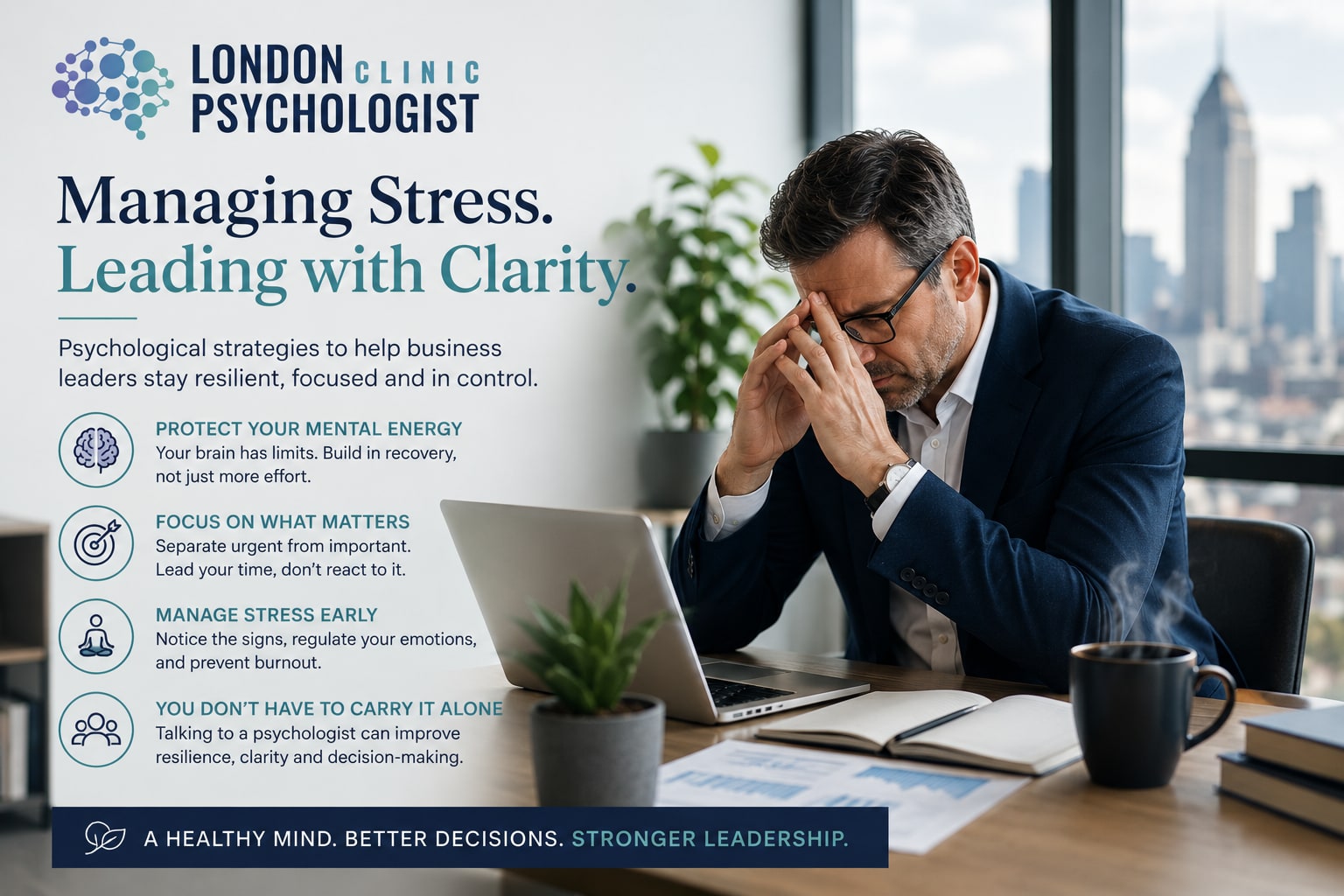
Understand That Your Brain Has Limits
Many successful professionals believe they should be capable of operating at maximum capacity indefinitely. However, the human brain simply does not function this way. Prolonged exposure to stress hormones, particularly cortisol, affects areas of the brain responsible for planning, attention, memory and emotional regulation. As stress accumulates, people often become more impulsive, less flexible in their thinking and increasingly focused on immediate problems rather than long-term strategy.
Rather than seeing mental fatigue as a sign of weakness, it is more helpful to recognise it as an indication that your brain requires recovery. Just as muscles need time to repair after physical exertion, the brain also requires periods of rest to maintain peak performance.
Separate What Feels Urgent From What Is Truly Important
One of the most common psychological effects of stress is the tendency to perceive every issue as equally urgent. Emails demand immediate responses, minor setbacks feel like crises and decision-making becomes driven by pressure rather than perspective.
A useful psychological technique is to pause and ask yourself, "Will this still matter in six months?" This simple question encourages the brain to shift from emotional, reactive thinking towards more rational, strategic decision-making. Often, the perceived urgency begins to diminish, allowing clearer judgement.
Challenge Perfectionistic Thinking
Many executives have built successful careers by maintaining exceptionally high standards. However, perfectionism often becomes one of the greatest contributors to chronic stress.
Thoughts such as:
- If I don't do it myself, it won't be done properly.
- I can't afford to make mistakes.
- I should always be available.
...may initially appear to reflect commitment, but over time they can lead to exhaustion, micromanagement and burnout. Psychology encourages leaders to distinguish between perfection and excellence. Excellence allows room for learning, delegation and realistic expectations, whereas perfection often demands an impossible standard that no individual can consistently maintain.
Learn to Recognise Your Personal Stress Signals
Burnout rarely develops overnight. Instead, stress usually begins with subtle psychological and physical changes that are easily overlooked during busy periods.
Common early warning signs include:
- Increased irritability.
- Difficulty concentrating.
- Forgetfulness.
- Poor quality sleep.
- Racing thoughts.
- Feeling emotionally detached from work or family.
- Reduced enjoyment in achievements that once felt rewarding.
Recognising these signs early provides an opportunity to make adjustments before stress becomes significantly more difficult to manage.
Treat Recovery as Part of High Performance
Many leaders view recovery as something they will prioritise once work becomes less demanding. Unfortunately, that moment often never arrives.
Elite athletes understand that performance improves through a balance of effort and recovery. The same principle applies to executive functioning. Regular periods away from work, exercise, meaningful social connection, hobbies and uninterrupted sleep are not indulgences; they are essential components of sustained cognitive performance.
Psychologically, recovery allows the brain's executive functions to replenish, improving attention, creativity, emotional regulation and decision-making.
Be Aware of Cognitive Biases
Stress changes not only how we feel but also how we think. Under pressure, the brain increasingly relies on mental shortcuts, known as cognitive biases, which can distort judgement.
For example, executives may become more likely to focus on negative information, overestimate potential risks or seek evidence that confirms existing concerns while overlooking alternative explanations.
Before making significant decisions, ask yourself, "What evidence might suggest that my current assumption is incorrect?" This question encourages more balanced thinking and helps reduce emotionally driven decision-making.
Develop Psychological Flexibility
One of the strongest predictors of resilience is not toughness but psychological flexibility. This refers to the ability to adapt when circumstances change, tolerate uncertainty and continue making decisions that align with long-term goals rather than short-term emotions.
Business environments are rarely predictable. Leaders who remain psychologically flexible are better able to navigate setbacks, adapt to change and maintain perspective during periods of uncertainty.
Don't Carry the Burden Alone
Leadership can be surprisingly isolating. Many executives feel unable to discuss uncertainty, stress or self-doubt because they believe they must always appear confident and in control.
Working with a psychologist provides a confidential space to explore these pressures without judgement. Therapy can help identify unhelpful thinking patterns, improve emotional regulation, strengthen resilience and develop practical strategies for managing the psychological demands of leadership.
Seeking support should never be viewed as a sign of weakness. In many cases, it reflects a commitment to becoming a more effective leader while protecting long-term wellbeing.
Looking After Yourself Is Good Leadership
The most successful business leaders understand that sustainable performance is not achieved by working relentlessly or ignoring stress. It comes from developing the psychological skills needed to think clearly under pressure, regulate emotions effectively and make thoughtful decisions, even during challenging periods.
Investing in your psychological wellbeing is not simply beneficial for you personally. It also influences the people you lead, the culture you create and the long-term success of your organisation. Strong leadership begins with a healthy mind, and understanding the psychology of stress is one of the most valuable investments any executive can make.