


Executive Paralysis

posted 14th November 2026
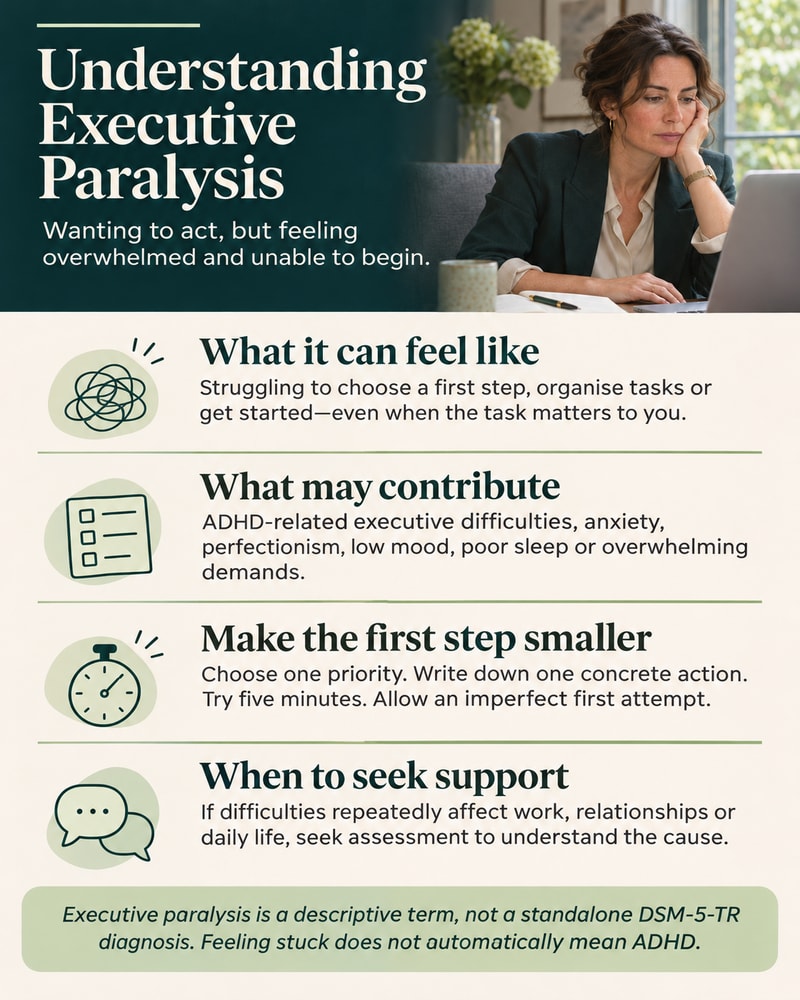
Executive Paralysis: When You Want to Act but Feel Unable to Start
You know what needs doing. You understand why it matters. You may have spent hours thinking about it. Yet when you try to begin, you feel mentally frozen.
An unanswered email becomes harder to open. A simple form feels like a series of impossible decisions. You move between tabs, make another list or scroll on your phone, while becoming increasingly distressed about the task you are avoiding.
This experience is often described as executive paralysis. It can help name the gap between intending to do something and being able to organise yourself to do it. Understanding that gap requires more than telling yourself to try harder.
What is executive paralysis?
Executive paralysis is an informal term for feeling overwhelmed and unable to initiate, organise or complete an intended task. “Paralysis” describes the subjective experience of being stuck; it does not mean a physical loss of movement.
The term overlaps with executive dysfunction, which describes difficulties with the mental processes that support purposeful activity. These include working memory, inhibitory control and cognitive flexibility, alongside higher-level abilities such as planning and problem-solving. [1]
Working memory helps you hold instructions in mind. Inhibitory control helps you resist distractions. Cognitive flexibility helps you change approach when circumstances change. If these processes are under strain, even an apparently straightforward task can become difficult to coordinate.
Executive dysfunction is broader than an episode of feeling frozen. It may also involve losing track of steps, difficulty switching activities or problems sustaining an organised approach.
Is executive paralysis a DSM-5-TR diagnosis?
Neither “executive paralysis” nor “ADHD paralysis” is a standalone diagnosis in the DSM-5-TR, the Diagnostic and Statistical Manual of Mental Disorders, Fifth Edition, Text Revision. “ADHD paralysis” is a descriptive expression used to discuss experiences of overwhelm and difficulty acting; it is not a separate ADHD subtype or a formal diagnostic criterion. [2]
The absence of a diagnostic label does not make the difficulty insignificant. It means that a clinician needs to understand the underlying pattern rather than treating the phrase as an explanation in itself.
A useful differential assessment considers whether the difficulties relate to ADHD, anxiety, depression, sleep problems, physical illness or other factors. More than one contributor may be present. [3]
How does it relate to ADHD?
ADHD is a neurodevelopmental disorder involving a persistent pattern of inattention and/or hyperactivity-impulsivity that interferes with functioning. For some adults, the difficulties are particularly noticeable when organising work, sustaining attention or completing lengthy tasks. [4]
A person may be deeply engaged in an interesting project yet struggle to begin routine administration. That contrast does not, by itself, establish either a lack of effort or a diagnosis of ADHD. The circumstances and the wider history matter.
DSM-5-TR assessment looks beyond a recent period of feeling overwhelmed. It considers a sustained symptom pattern, evidence that several symptoms were present before age 12, symptoms across at least two settings, and impairment. For adults, at least five symptoms in the relevant inattention and/or hyperactivity-impulsivity domain are required, alongside the other criteria. Symptoms must have persisted for at least six months and must not be better explained by another condition. [3]
An adult may only recognise longstanding difficulties when responsibilities increase or familiar support disappears. Assessment explores both current demands and developmental history. An online checklist or difficulty completing one task cannot establish the diagnosis. [5]
Why can anxiety and perfectionism leave you stuck?
Sometimes the main obstacle is what the task represents. Sending an email may mean risking criticism. Making a choice may mean accepting uncertainty. Starting a report may mean confronting the possibility that it will not meet your standards.
In a psychological formulation, perfectionistic beliefs such as “I must get this right first time” can turn an ordinary task into a test of personal worth. Intolerance of uncertainty can make choosing a reasonable next step feel unsafe unless every possible outcome has been considered.
Avoidance may then bring immediate relief. This is an example of negative reinforcement: escaping an uncomfortable feeling makes the same response more likely next time. The relief is temporary, while the task remains and the pressure grows.
This is one possible maintaining cycle, not a universal account of executive difficulties. A person can also struggle because the instructions are unclear, the workload is unrealistic or the environment is poorly suited to their needs.
How low mood can affect initiation
Depression can involve low energy, impaired concentration, indecisiveness and anhedonia—reduced interest or pleasure. Some people also experience psychomotor slowing, where movement and speech become noticeably slower. These symptoms can make everyday tasks more demanding. [6]
A person who previously managed their responsibilities may begin struggling to reply to messages, prepare meals or make decisions. That change deserves attention, especially when accompanied by persistent sadness, hopelessness or a loss of enjoyment.
Difficulty starting tasks alone does not establish depression. A clinician assesses the broader symptom pattern, duration, impact and possible alternative explanations.
Is it different from procrastination?
There is no simple clinical boundary separating “paralysis” from procrastination. Procrastination can also involve distress, avoidance and difficulty regulating emotions. It is unhelpful to assume that one term describes a genuine struggle while the other necessarily means laziness.
More useful questions are: What happens when I try to start? What is the obstacle? How often does this occur? What helps, and what makes it worse?
For example, someone may need help identifying the first step, while another person knows the first step but fears making a mistake. Similar outward behaviour can require different support.
The cycle of overwhelm and self-criticism
Consider a fictional example. Alex needs to prepare a presentation. The instructions are broad, several deadlines compete for attention and Alex worries about appearing incompetent. Instead of drafting the slides, Alex repeatedly researches the topic and reorganises notes.
As time passes, the thought “I am useless” increases distress. The presentation now feels even harder to approach. Researching provides a sense of activity, but does not resolve the uncertainty about what to produce.
A formulation might identify unclear expectations, fear of evaluation and avoidance as maintaining factors. It would also ask whether similar organisational difficulties have existed since childhood. The example illustrates why understanding the pattern is more useful than assuming a cause.
Practical ways to make starting easier
The aim is to reduce unnecessary demands and make the next action clearer. These are strategies to try, rather than a test of willpower or a substitute for assessment.
Define one visible action.
Replace “sort out my finances” with “open the latest statement”. A useful first step is specific enough that you know when it is complete.
Move information out of your head.
Write down the essential steps in one place. A short, usable list is often more helpful than repeatedly redesigning an elaborate system.
Reduce competing choices.
Select one immediate priority and put unrelated tasks somewhere you can return to later.
Separate drafting from judging.
If perfectionism is involved, allow a rough first attempt before reviewing it. “Write three imperfect sentences” creates a different demand from “write something excellent”.
Try a brief, bounded start.
Set aside five minutes for the first step, then reassess. The purpose is to make beginning manageable, not to force yourself through exhaustion.
Use appropriate support.
Ask for clearer instructions, an agreed priority or a brief check-in. Some people find quiet company helpful while starting a task.
Notice the emotion.
Ask whether you feel confused, bored, anxious, ashamed or depleted. Identifying the barrier helps you choose a response.
Strategies need to fit the person. If repeated attempts do not help, that is information about the support required, not evidence of a character flaw.
How can a psychologist help?
A psychologist can develop an individual formulation of the problem, bringing together cognitive processes, emotional responses, developmental history and current circumstances.
Cognitive behavioural therapy (CBT) may address avoidance, perfectionism and self-critical beliefs. Practical work may include task planning, environmental adjustments and structured problem-solving. Where depression is central, behavioural activation can help rebuild manageable engagement with meaningful activities.
For adults with ADHD, treatment should be tailored to the level of impairment and individual needs. NICE recommends environmental modifications and, where indicated, medication prescribed and monitored by an appropriately qualified clinician. Structured psychological intervention focused on ADHD may also be appropriate and can include CBT. [5]
Therapy cannot remove an unreasonable workload. Sometimes progress also requires clearer expectations, practical assistance or changes to working conditions.
When to seek support
Seek professional advice if these difficulties repeatedly affect work, study, relationships or basic daily tasks. A GP can consider physical and mental health contributors and discuss referral where needed. A new or marked deterioration should not automatically be attributed to ADHD.
At the London Psychologist Clinic, we can help you explore overwhelm, avoidance, low mood and self-criticism, and consider appropriate next steps. To enquire about psychological support, email info@londonpsychologistclinic.co.uk.
Wanting to act and being able to organise action are different processes. Understanding what stands between them can make support more effective—and self-blame less necessary.
This article provides general information and is not a substitute for an individual assessment.
References and further reading
Cleveland Clinic.
Executive Dysfunction.
Attention Deficit Disorder Association.
ADHD Paralysis.
A patient information resource using an informal descriptive term.
National Institute of Mental Health.
Attention-Deficit/Hyperactivity Disorder: What You Need to Know.
American Psychiatric Association.
ADHD in Adults;
Diagnostic and Statistical Manual of Mental Disorders,
Fifth Edition, Text Revision (2022).
National Institute for Health and Care Excellence.
Attention deficit hyperactivity disorder: diagnosis and management (NG87).
National Institute for Health and Care Excellence.
Depression in adults: treatment and management (NG222).