


Doomscrolling Anxiety
posted 8th May 2026
Doomscrolling, Anxiety, and the Modern Mind: Why We Struggle to Switch Off
For many people, checking the news or social media has become an almost automatic part of daily life. A quick glance at headlines during breakfast can easily turn into an hour of scrolling through distressing stories, political conflict, economic fears, health scares, online arguments, and emotionally charged content. Increasingly, psychologists are examining the impact this constant exposure to negative information may have on mental wellbeing.
This behaviour is often referred to as “doomscrolling” — the compulsive consumption of negative or anxiety-provoking online content, particularly through social media and news platforms. While staying informed is not inherently unhealthy, prolonged exposure to emotionally activating information can begin affecting mood, stress levels, concentration, sleep, and anxiety.
From a psychological perspective, doomscrolling is not simply a matter of poor self-control. Human brains are naturally wired to pay attention to threat-related information. Evolutionarily, noticing danger increased survival. Negative information therefore tends to capture attention more strongly than neutral or positive information — a phenomenon psychologists sometimes refer to as negativity bias.
Modern technology exploits this tendency remarkably well.
Social media platforms and news algorithms are designed to maximise engagement, and emotionally provocative content is more likely to keep people scrolling. Stories that trigger fear, outrage, uncertainty, or shock often receive greater visibility because they generate stronger emotional reactions. The result is that many individuals become trapped in cycles of consuming information that continually activates stress and threat responses.
Psychologically, uncertainty plays a major role. During periods of social instability, economic concern, global conflict, or personal stress, people often seek information in an attempt to regain a sense of control. Ironically, excessive information-seeking can sometimes increase anxiety rather than reduce it.
For individuals already prone to anxiety disorders, obsessive thinking, or health anxiety, doomscrolling may reinforce hypervigilance and catastrophic thinking patterns. Someone worried about their health may repeatedly search symptoms online. A person anxious about safety or world events may compulsively monitor breaking news. While this behaviour may initially feel reassuring, it often prolongs physiological arousal and emotional distress.
Within the Diagnostic and Statistical Manual of Mental Disorders, Fifth Edition (DSM-5), anxiety-related difficulties are characterised not only by fear itself, but by persistent worry, heightened arousal, cognitive preoccupation, and difficulty disengaging from perceived threats. Doomscrolling can unintentionally maintain these patterns by keeping the nervous system in a constant state of alertness.
Many people notice the effects physically as well as emotionally. Excessive exposure to stressful content may contribute to:
- sleep disruption
- irritability
- racing thoughts
- difficulty concentrating
- emotional exhaustion
- muscle tension
- feelings of helplessness
- heightened stress responses
The timing of doomscrolling also matters. Many individuals scroll late at night, when emotional resilience is naturally lower and the brain is more vulnerable to anxiety-based thinking. Exposure to distressing information before sleep can prolong cognitive arousal, making it harder for the nervous system to settle.
Another important issue is emotional desensitisation and overwhelm. Constant exposure to global crises and emotionally intense material can create a psychological sense that the world is permanently unsafe or chaotic. Some individuals begin feeling emotionally numb, detached, or persistently pessimistic after prolonged exposure to highly negative online environments.
Importantly, psychology does not suggest that people should avoid news or ignore reality. Staying informed can be valuable and socially responsible. The issue is not awareness itself, but the relationship someone develops with information consumption.
Healthy engagement with news tends to involve boundaries, intentionality, and emotional regulation. Doomscrolling, by contrast, is often compulsive, emotionally driven, and difficult to stop despite worsening mood or anxiety.
One of the most effective psychological strategies is not necessarily consuming less information altogether, but becoming more aware of how certain content affects emotional state. Limiting exposure before bed, reducing repetitive checking behaviours, curating healthier online environments, and creating intentional breaks from social media may help reduce chronic nervous system activation.
Therapy can also help individuals recognise the underlying anxiety patterns driving compulsive information-seeking. For some people, doomscrolling reflects deeper fears around uncertainty, control, safety, or helplessness that extend beyond the content itself.
Modern humans were not psychologically designed to absorb an endless stream of global crises, conflict, outrage, and emotionally charged information every hour of the day. Yet many people now live in exactly that environment.
Ultimately, protecting mental wellbeing in the digital age increasingly requires not only awareness of what we consume online, but awareness of what our minds and nervous systems were never designed to process continuously.
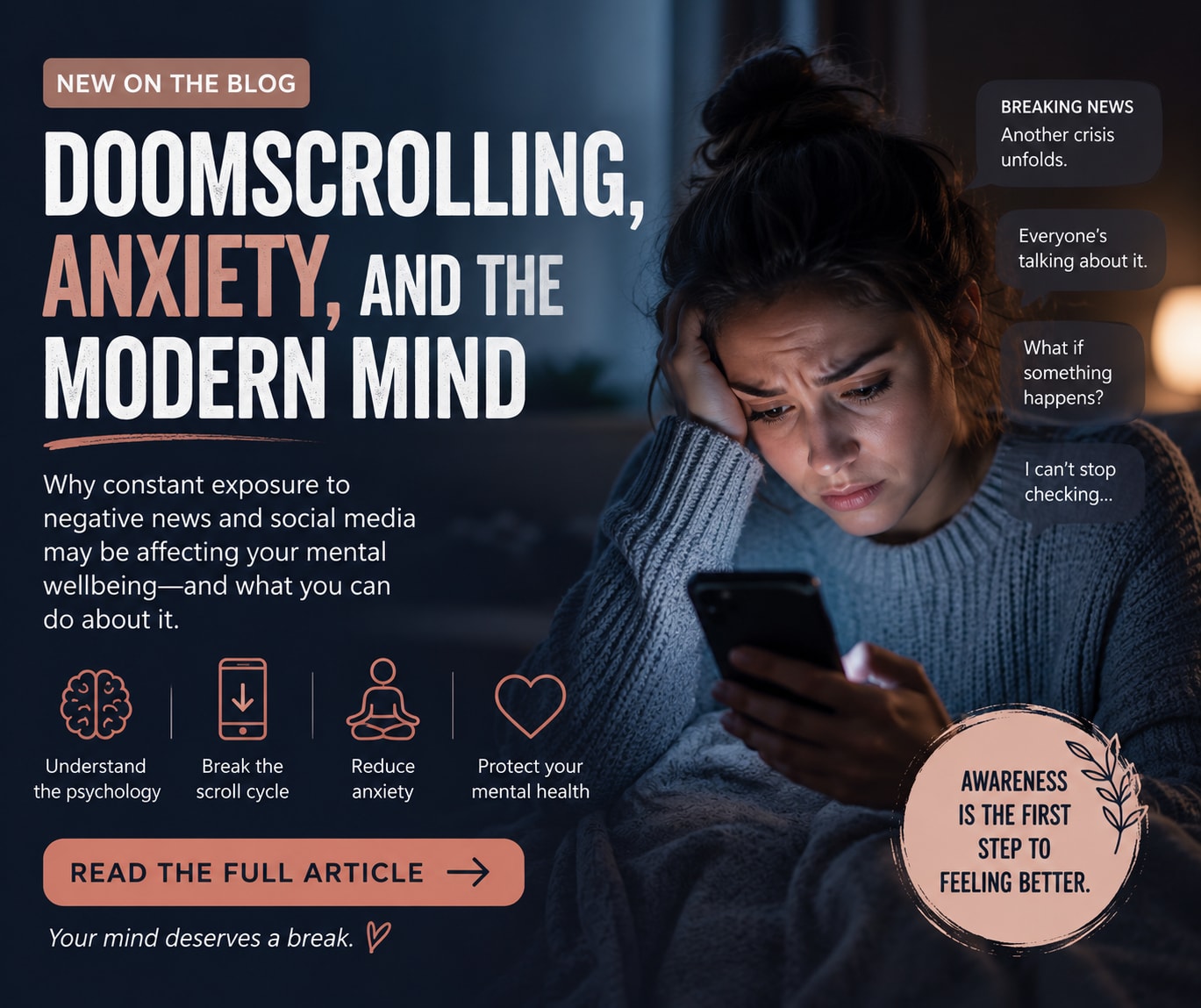
Click image to enlarge