


Does ' Feel the Fear and Do it Anyway' Work?
posted 29th April 2026
Why “Feel the Fear and Do It Anyway” Works: A Psychological Perspective
At our clinic, we often hear a familiar dilemma: “I know I should do it, but I feel too anxious.” The phrase “feel the fear and do it anyway” captures something important, but without context it can sound simplistic or even dismissive. From a psychological perspective, however, this idea is strongly supported by evidence-based theory and clinical practice.
Approaching fear—rather than avoiding it—is one of the most effective ways to reduce anxiety. This principle is grounded in well-established frameworks, including DSM-5-informed understandings of anxiety disorders, Cognitive Behavioural Therapy (CBT), and contemporary behavioural science.
Understanding Fear: A Normal but Misleading Signal
Fear is a natural and adaptive response designed to protect us from threat. When we perceive danger, the body activates physiological systems—such as increased heart rate, muscle tension, and heightened alertness—to prepare for action.
However, in many anxiety-related conditions described in the DSM-5-TR, including Generalised Anxiety Disorder, Social Anxiety Disorder, Panic Disorder, and Specific Phobias, this system becomes overgeneralised or misapplied. The mind begins to interpret situations as threatening even when they are not objectively harmful. As a result, the experience of fear becomes disconnected from actual risk.
Importantly, the feeling of fear does not necessarily indicate that something is dangerous.
The Role of Avoidance in Maintaining Anxiety
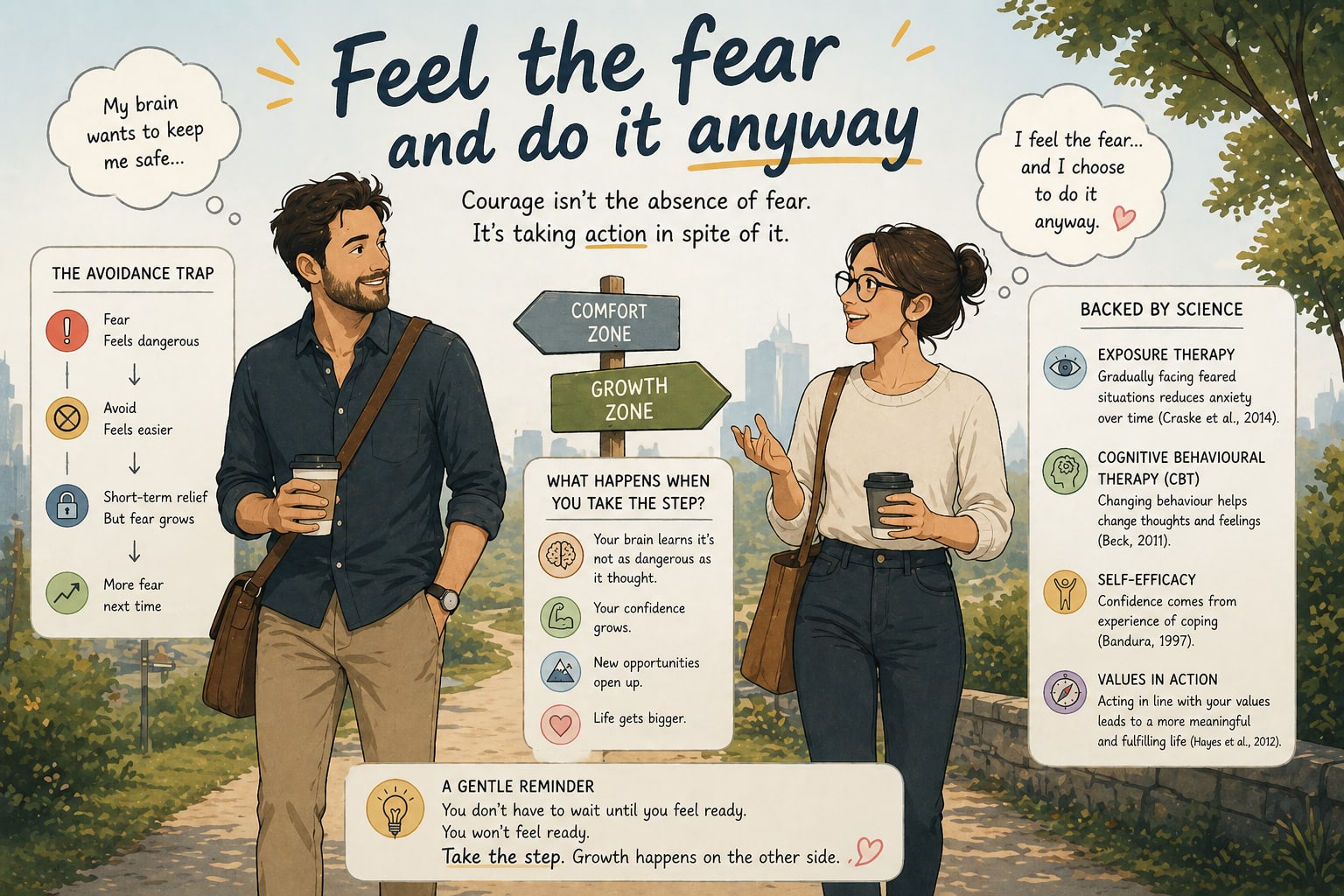
A central factor in the persistence of anxiety is avoidance. When something feels uncomfortable or threatening, the natural response is to withdraw, delay, or escape. While this provides short-term relief, it reinforces the belief that the situation is unsafe.
Over time, this creates a self-perpetuating cycle: fear leads to avoidance, avoidance reduces anxiety temporarily, and this relief strengthens the fear response in the future. The individual never has the opportunity to learn that the situation may be manageable or less threatening than anticipated.
Why Acting Despite Fear Works: The Science of Exposure
One of the most effective evidence-based treatments for anxiety is exposure, a core component of CBT. Exposure involves gradually and repeatedly facing feared situations without relying on avoidance or safety behaviours.
Through this process, the nervous system begins to adapt. The initial intensity of the fear response reduces over time, a process known as habituation. More importantly, new learning occurs. The brain updates its expectations and begins to recognise that the situation is not as dangerous as previously believed, and that the individual is capable of coping.
This process, often referred to as inhibitory learning, is fundamental to long-term change. As confidence increases and avoidance decreases, anxiety becomes less dominant.
Cognitive Change Through Behaviour
CBT emphasises the close relationship between thoughts, emotions, and behaviour. While many people attempt to reduce anxiety by changing their thoughts first, research consistently shows that behavioural change often precedes cognitive change.
When someone takes action despite feeling anxious, they gather new evidence. Their beliefs begin to shift not because they have been reassured, but because they have directly experienced a different outcome. Over time, this leads to a natural reduction in anxiety and a more balanced interpretation of situations.
Building Confidence: The Role of Self-Efficacy
A key concept in understanding this process is self-efficacy—the belief in one’s ability to manage challenges. Self-efficacy is not built through positive thinking alone; it develops through experience.
Each time a person faces a feared situation and copes, even imperfectly, their sense of capability increases. Confidence, therefore, is not something that needs to be present before action. It is something that emerges as a result of action.
Acceptance: You Don’t Have to Eliminate Fear
Modern approaches such as Acceptance and Commitment Therapy (ACT) offer an important refinement. Rather than focusing solely on reducing fear, they emphasise changing the relationship with it.
Fear does not need to be eliminated in order for someone to live a meaningful life. It can be present while the individual continues to act in line with their values, engage in important activities, and move towards what matters. This represents a shift from trying to control internal experiences to focusing on purposeful action.
It is important to clarify that “feeling the fear and doing it anyway” does not mean ignoring distress or pushing through overwhelming situations without support. When applied clinically, it involves gradual, structured, and appropriately supported exposure.
Psychologically, the principle is about recognising fear as a normal internal experience, while choosing behaviour based on long-term goals and values rather than short-term relief.
Avoidance tends to narrow life. Approach tends to expand it.
One of the most powerful shifts a person can make is moving from “I will act when I feel better” to “I will act, and feeling better will follow.” This shift is not about dismissing fear, but about understanding how change actually occurs.
If you would like support in applying these principles in a safe and structured way, our clinicians are experienced in evidence-based approaches including CBT and exposure-based therapy.
Click to enlarge