

Digital Addiction
posted 17th April 2026
Dopamine Dysregulation and Digital Addiction
In recent years, increasing attention has been given to the psychological impact of excessive smartphone and social media use, often described in popular discourse as “dopamine addiction.” While not a formal diagnostic category, this phenomenon reflects clinically recognised patterns of behavioural addiction, emotional dysregulation, and reward-system sensitivity. As digital platforms become more immersive and algorithm-driven, many individuals are experiencing difficulties with attention, impulse control, and mood regulation, making this an increasingly relevant issue in both public and clinical contexts.
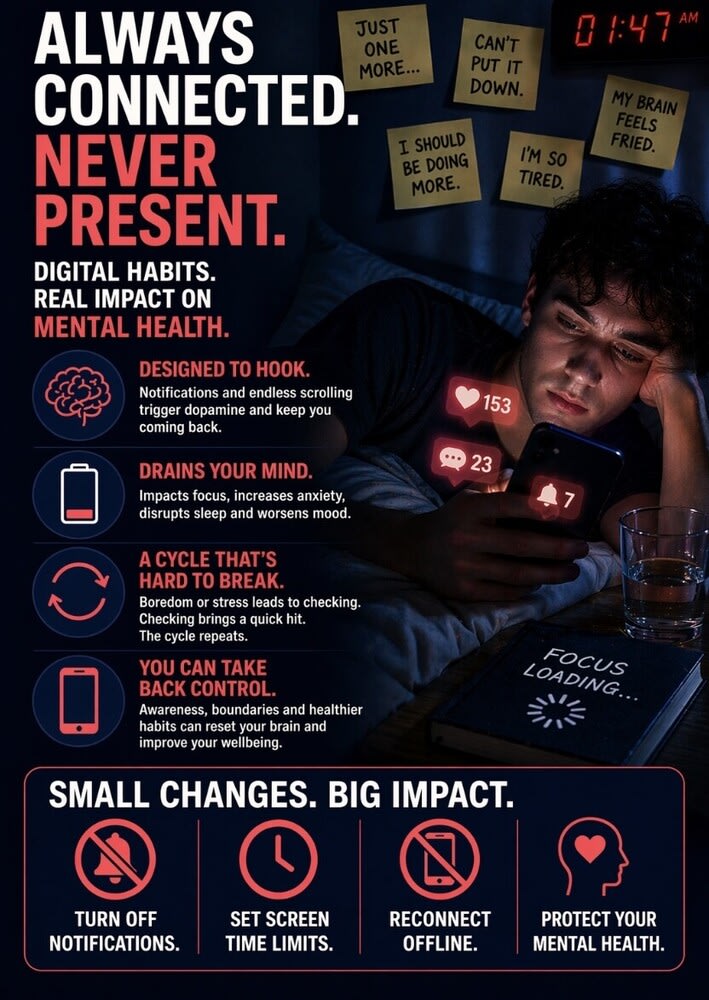
At a psychological level, digital platforms are designed to exploit the brain’s reward system. Intermittent reinforcement—through notifications, likes, messages, and new content—triggers dopamine release, reinforcing repeated engagement. Over time, this can lead to compulsive checking behaviours, reduced tolerance for boredom, and difficulty disengaging from devices. Individuals may find themselves repeatedly reaching for their phone without conscious intention, even when it interferes with work, relationships, or rest.
This pattern is often accompanied by broader cognitive and emotional consequences. Research suggests that excessive digital consumption is associated with reduced attention span, increased anxiety, sleep disruption, and decreased overall wellbeing. From a cognitive-behavioural perspective, these behaviours are maintained through habit loops: cues (e.g., boredom or stress) trigger checking behaviours, which provide temporary relief or stimulation, reinforcing the cycle. Over time, individuals may become increasingly reliant on digital input to regulate mood and avoid discomfort.
Importantly, digital overuse is not solely about time spent online, but about the function it serves. Many individuals use their devices as a form of emotional avoidance—escaping from stress, uncertainty, or negative affect. This can prevent the development of healthier coping strategies and contribute to a cycle of avoidance and dependency. In this sense, the issue is less about technology itself and more about the relationship individuals develop with it.
Treatment approaches draw on principles from Cognitive Behavioural Therapy (CBT) and behavioural addiction models. Interventions often focus on increasing awareness of usage patterns, identifying triggers, and restructuring unhelpful habits. Techniques such as stimulus control (e.g., limiting notifications), scheduled use, and behavioural substitution can help reduce compulsive engagement. Increasingly, mindfulness-based strategies are also used to help individuals tolerate boredom and reduce automatic reactivity to digital cues.
A key component of treatment is restoring balance. This may involve reintroducing offline activities that provide meaningful reward, such as social interaction, physical activity, and hobbies. Addressing underlying psychological factors—such as anxiety, loneliness, or low mood—is also essential, as these often drive excessive digital use. For some individuals, particularly younger populations, psychoeducation around the impact of algorithms and digital design can be empowering in promoting more intentional use.
In conclusion, dopamine dysregulation linked to digital overuse represents a modern extension of well-established psychological principles of reinforcement and habit formation. As technology continues to evolve, so too must our understanding of its impact on mental health. Evidence-based psychological approaches offer effective strategies for reducing compulsive use and improving emotional regulation. For psychology clinics, this presents an opportunity to address a highly relevant and increasingly prevalent concern with nuanced, contemporary interventions.