


Decision Fatigue and The Battery
posted 15th June 2026
Why Good Decisions Become Harder Throughout the Day
Most professionals like to think they make rational decisions. Whether it is leading a team, managing a business, making financial choices, or prioritising tasks, we often assume that our ability to make decisions remains relatively constant throughout the day. Occupational psychology suggests otherwise.
The quality of our decision-making can deteriorate as mental resources become depleted. The more decisions we make, the harder it becomes to think clearly, evaluate options, and exercise self-control. One helpful way to understand this process is through the analogy of a battery.
The Battery That Powers Every Decision
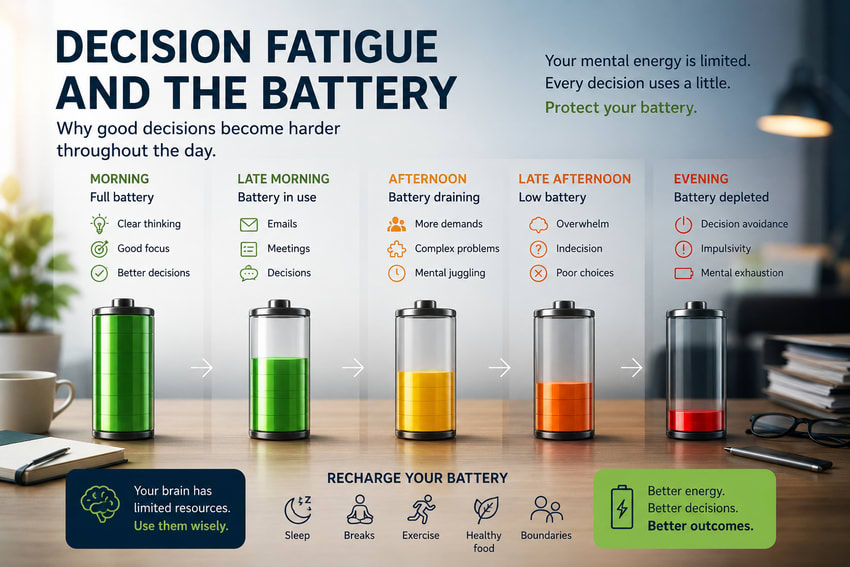
Imagine starting each morning with a fully charged battery. Every choice you make draws a small amount of power from it. Some decisions require very little energy, while others require considerably more.
Responding to emails, managing competing priorities, handling difficult conversations, solving problems, and making strategic decisions all consume mental resources throughout the day. At first, the battery functions well. You think clearly, weigh up options carefully, consider long-term consequences, and make thoughtful decisions.
As the battery gradually drains, however, the brain begins looking for shortcuts.
The Psychology Behind Decision Fatigue
Decision fatigue refers to the decline in decision-making quality that occurs after prolonged periods of cognitive effort. The brain is constantly processing information, evaluating options, and regulating behaviour. These activities require psychological resources.
As those resources become depleted, people often experience reduced concentration, poorer judgement, increased impulsivity, and difficulty evaluating alternatives. Occupational psychology shows us that decision-making is not simply a matter of intelligence or expertise. It is also heavily influenced by cognitive capacity, stress, fatigue, and mental energy.
Even highly capable professionals can make poorer decisions when mentally exhausted.
Why the Brain Prefers Shortcuts
As mental energy decreases, the brain begins relying on shortcuts. These shortcuts help reduce effort, but they can also increase bias and errors.
Someone experiencing decision fatigue may delay important decisions, choose the easiest option rather than the best one, avoid difficult conversations, act impulsively, or become overwhelmed by relatively simple choices. The brain is attempting to conserve energy, much like a phone entering low-power mode when its battery is running low.
How Decision Fatigue Affects the Workplace
Decision fatigue can have significant consequences in professional environments. Leaders often make dozens of decisions each day, many of which involve uncertainty, competing priorities, and high levels of responsibility.
As mental resources become depleted, decision quality may begin to decline. Employees may find themselves procrastinating, struggling to prioritise tasks, becoming indecisive, or avoiding complex problems altogether. What appears to be poor motivation is often a reflection of cognitive exhaustion.
The Link Between Decision Fatigue and Burnout
Decision fatigue and burnout are closely connected. When individuals experience chronic workplace stress, the mental battery is often already partially depleted before the day even begins.
Tasks that would normally feel manageable start requiring significantly more effort. Decision-making becomes slower. Concentration becomes harder. Small problems begin to feel disproportionately overwhelming. Over time, this can contribute to emotional exhaustion, reduced performance, and a growing sense of frustration.
Why Successful People Reduce Decisions
Many high-performing professionals intentionally reduce unnecessary decisions. This is not because they lack flexibility. It is because they recognise that mental energy is a valuable resource.
Creating routines, systems, and habits helps preserve cognitive capacity for decisions that genuinely matter. For example, planning meals, structuring workdays, using clear decision rules, and delegating where appropriate can all reduce unnecessary cognitive load.
The aim is not to remove all decisions from life. Rather, it is to ensure that mental energy is not wasted on low-value choices that leave less capacity for important ones.
Recharging the Battery
One of the most important lessons from decision fatigue is that mental resources are not unlimited. Just as a battery requires recharging, cognitive performance depends on recovery.
Sleep, breaks, exercise, nutrition, boundaries, and workload management all influence decision-making capacity. Taking breaks is not a sign of weakness. It is often an essential component of maintaining high performance.
People who regularly recharge their psychological resources are often able to make better decisions than those who attempt to work continuously without recovery.
How Psychology Can Help
For some professionals, decision fatigue becomes a recurring problem that affects performance, confidence, and wellbeing. Therapy and executive coaching can help individuals identify the factors contributing to cognitive overload and develop strategies for managing mental resources more effectively.
Occupational psychology can be particularly helpful for professionals experiencing stress, perfectionism, burnout, leadership challenges, and decision-making difficulties. Evidence-based approaches can help individuals improve self-awareness, manage workload demands, build sustainable performance habits, and understand the psychological patterns that may be keeping them stuck.
Making Better Decisions Starts With Managing Energy
Many people assume that improving decision-making requires working harder or thinking longer. In reality, better decisions often begin with protecting the mental resources that make good thinking possible.
Your brain is not an unlimited resource. Like any battery, it performs best when it is regularly recharged and carefully managed. Understanding decision fatigue allows professionals to work with their psychology rather than against it.
Seeking Professional Support
If workplace stress, cognitive overload, burnout, or decision fatigue are affecting your performance or wellbeing, professional support can help.
At The London Psychologist Clinic, we work with professionals, executives, and business leaders to improve resilience, manage workplace stress, and optimise psychological performance. Understanding how your mind works is often the first step towards working more effectively.