


Decision Fatigue
posted 16th July 2026
Click to enlarge image
Decision Fatigue: Why Even the Best Leaders Make Poor Decisions by the End of the Day
Business leaders are expected to make countless decisions every day. Some are relatively straightforward, while others can shape the future of an organisation. From managing staff and finances to responding to clients and planning for growth, executives often spend their entire working day making judgement calls. Yet few realise that the quality of those decisions changes as mental energy becomes depleted.
Psychologists refer to this phenomenon as decision fatigue. It describes the gradual decline in the quality of decision-making after an extended period of making choices. Rather than reflecting intelligence or capability, decision fatigue is a normal consequence of how the human brain allocates its cognitive resources.
Understanding how decision fatigue develops can help professionals protect their performance, improve their leadership and reduce unnecessary stress.
The Brain Has a Limited Decision-Making Capacity
Every decision, no matter how small, draws upon the brain's executive functions. These include attention, working memory, problem-solving and self-control, processes that are largely managed by the prefrontal cortex.
Throughout the day, these mental resources are gradually consumed. As cognitive energy declines, the brain naturally seeks ways to conserve effort. Rather than carefully evaluating information, we begin relying on mental shortcuts, habits or emotional reactions.
This explains why many people find themselves making poorer decisions towards the end of a busy day despite having more experience and knowledge than ever before.
The Hidden Cost of Constant Choice
Modern workplaces expose professionals to an extraordinary number of daily decisions.
- Responding to emails.
- Managing staff issues.
- Reviewing financial information.
- Prioritising competing demands.
- Attending meetings.
- Making strategic business decisions.
- Resolving unexpected problems.
While each decision may appear relatively minor in isolation, together they place a considerable burden on the brain. Over time, this constant demand reduces mental efficiency and increases psychological fatigue.
How Decision Fatigue Affects Performance
Decision fatigue rarely announces itself. Instead, it subtly alters the way people think.
Some professionals begin avoiding decisions altogether. Others become impulsive, making rapid choices simply to reduce the discomfort of uncertainty. Some become overly cautious, delaying important decisions because every option feels mentally overwhelming.
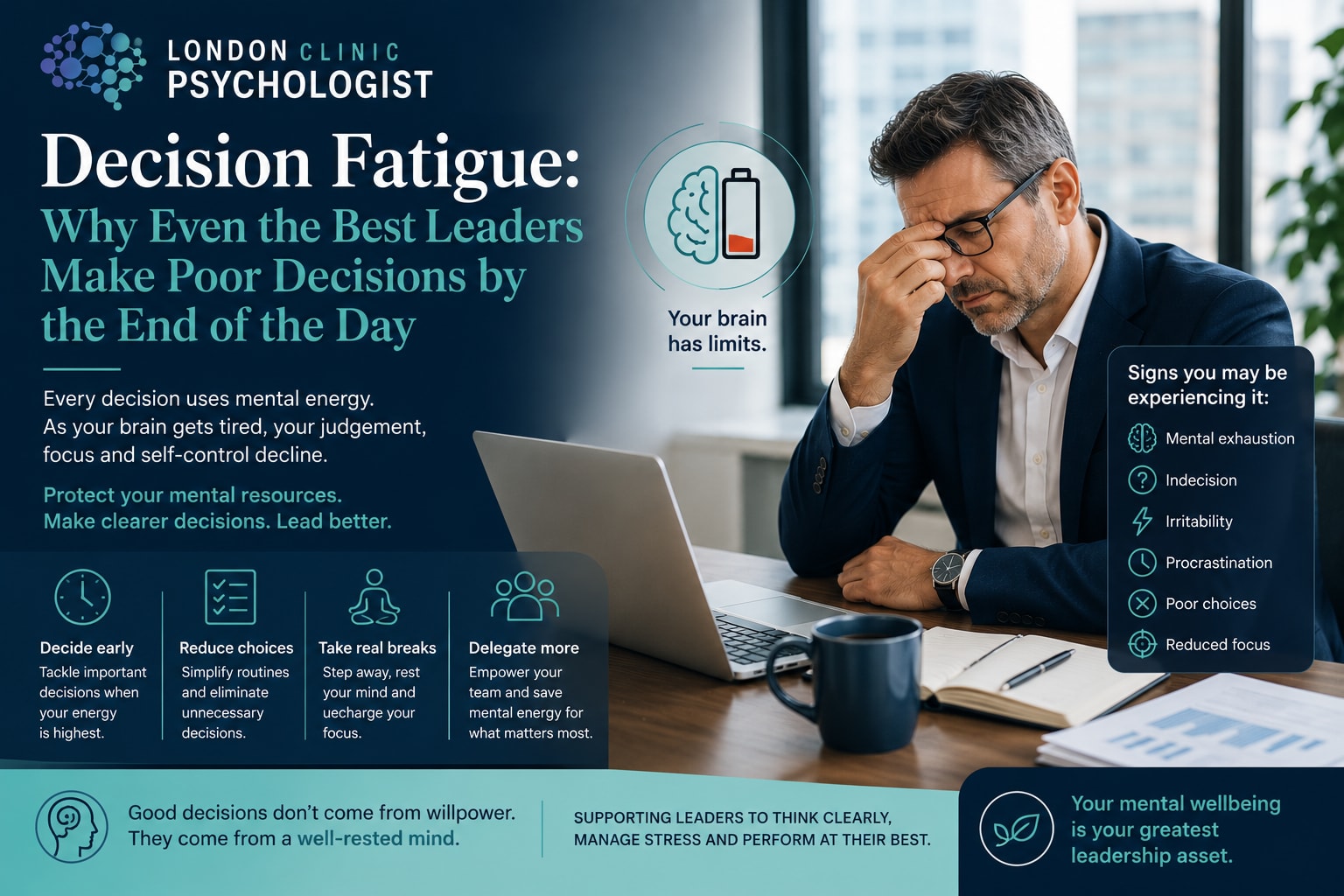
Common signs include:
- Difficulty concentrating.
- Procrastination.
- Feeling mentally exhausted despite limited physical activity.
- Becoming increasingly indecisive.
- Choosing the easiest option rather than the best one.
- Greater emotional reactivity.
- Reduced creativity and strategic thinking.
These changes are often mistaken for laziness or poor motivation when they are actually predictable consequences of cognitive overload.
Stress Makes Decision Fatigue Worse
Stress and decision fatigue reinforce one another.
When stress hormones remain elevated, the brain becomes increasingly focused on immediate threats rather than long-term planning. As emotional arousal increases, people become more reactive and less reflective.
This combination often explains why leaders under sustained pressure begin to lose confidence in decisions they would normally make with ease.
Why Successful Leaders Still Experience It
Decision fatigue affects everyone, regardless of intelligence or experience.
In fact, senior executives may be particularly vulnerable because they make proportionally more high-stakes decisions than most employees. They are also more likely to experience responsibility for organisational outcomes, financial pressures and the wellbeing of others.
The issue is not capability; it is the cumulative psychological demands placed upon the brain.
Psychological Strategies to Reduce Decision Fatigue
Fortunately, research suggests several practical ways to preserve cognitive performance throughout the working day.
Prioritise Important Decisions Early
Most people have their greatest mental capacity during the first few hours after waking. Whenever possible, schedule strategic meetings, difficult conversations and complex decisions during periods of peak concentration.
Reduce Unnecessary Choices
Many highly successful leaders deliberately simplify routine decisions.
Examples include:
- Creating structured daily routines.
- Using standard meeting templates.
- Scheduling recurring tasks.
- Reducing unnecessary interruptions.
- Delegating decisions that do not require executive input.
Reducing minor decisions preserves cognitive resources for issues that genuinely require careful thought.
Take Genuine Mental Breaks
Many professionals believe that checking emails during lunch represents a break. Psychologically, it does not.
The brain benefits from short periods of genuine recovery, such as walking outdoors, exercising, practising mindfulness or simply stepping away from technology for a few minutes.
These brief recovery periods improve attention and help restore executive functioning.
Recognise When You Are Mentally Depleted
One of the most valuable leadership skills is recognising when your judgement may be impaired.
If you notice increasing frustration, indecision or emotional thinking, it may be more effective to delay an important decision until your cognitive resources have recovered rather than forcing an immediate response.
How a Psychologist Can Help
Many professionals seek support because they feel overwhelmed, constantly exhausted or no longer trust their own judgement.
Working with a psychologist can help identify the patterns contributing to cognitive overload, perfectionism and chronic stress. Therapy also provides practical strategies for improving emotional regulation, strengthening resilience and protecting cognitive performance under pressure.
For many business leaders, the goal is not simply reducing stress. It is learning how to think more clearly, make better decisions and sustain high performance over the long term.
Good leadership depends on good decisions, and good decisions depend on a healthy, well-functioning mind. Decision fatigue is not a personal failing or a sign of weakness. It is a normal psychological process that affects everyone who carries significant responsibility.
By understanding how the brain manages cognitive energy and adopting evidence-based psychological strategies, business leaders can make clearer decisions, improve resilience and lead with greater confidence and effectiveness.