


Can You Remember Something That Never Happened?
posted 5th June 2026
Can You Remember Something That Never Happened? The Psychology of False Memories
Most of us trust our memories.
We rely on them to understand our past, make decisions and form our sense of identity. We often speak about memories as though they are recordings stored somewhere in the brain, ready to be replayed whenever needed.
But what if some of your most vivid memories never happened at all?
It may sound surprising, but psychological research has repeatedly demonstrated that human memory is far less reliable than most people realise.
At The London Psychologist Clinic, we often help clients understand how memory, emotion and perception interact. One of the most fascinating discoveries in psychology is that the brain does not simply retrieve memories—it actively reconstructs them.
What Is a False Memory?
A false memory is a recollection of an event that either never occurred or occurred differently from the way it is remembered.
The memory often feels completely real.
In fact, people can be highly confident in memories that are partially or entirely inaccurate.
False memories can involve:
- Childhood experiences
- Conversations
- Details of significant events
- Where objects were placed
- What someone said
- Personal experiences that never occurred
The important point is that these memories are not deliberate lies.
The individual genuinely believes them to be true.
Why Does the Brain Create False Memories?
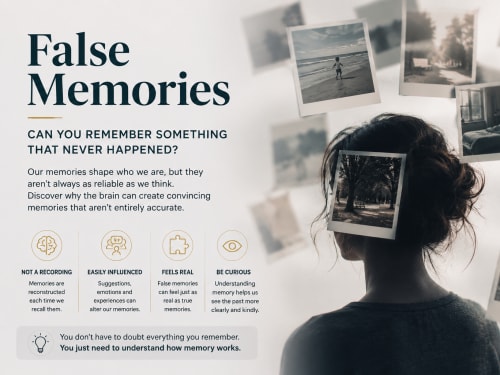
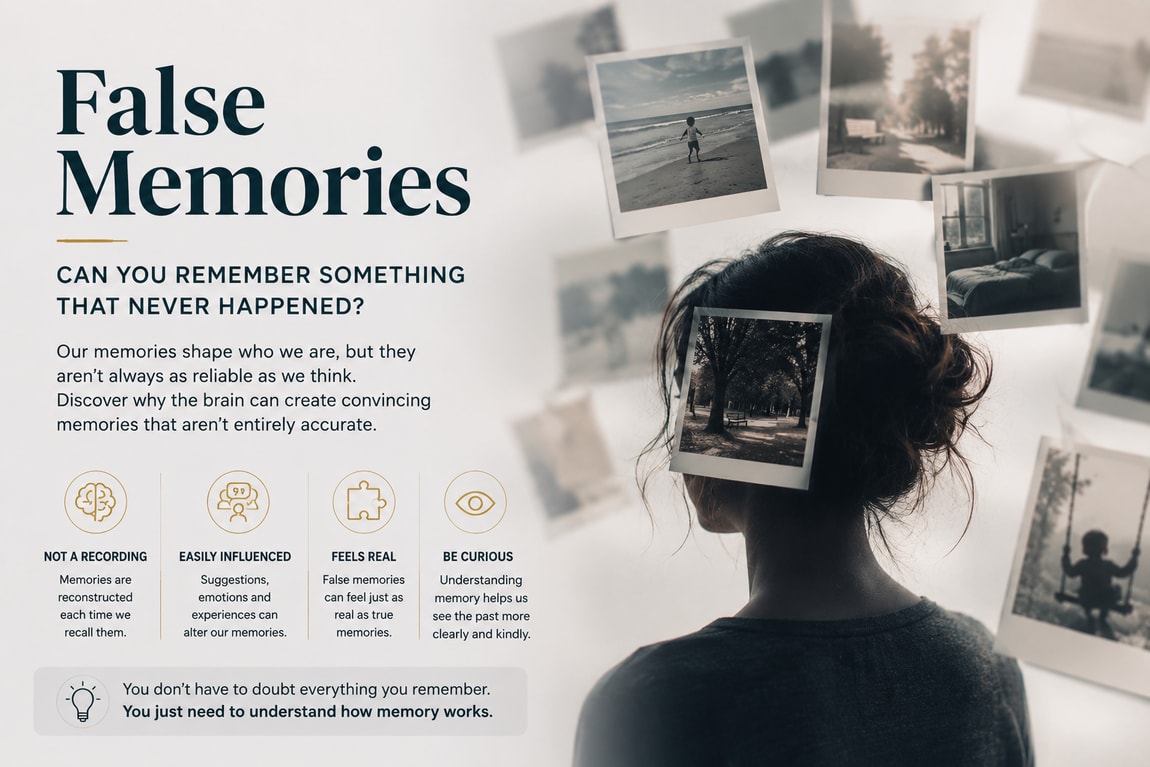
Memory is not like a video recording.
Each time we remember something, the brain reconstructs the event using fragments of stored information, emotions, beliefs and expectations.
This process is generally efficient, but it can also create errors.
Psychologists believe memories can become distorted through:
- Suggestions from others
- Repeated retelling of events
- Exposure to photographs
- Media coverage
- Leading questions
- Personal beliefs and assumptions
Over time, these influences can become woven into the memory itself.
The Famous "Lost in the Mall" Experiment
One of the most influential studies on false memories was conducted by psychologist Elizabeth Loftus.
Participants were provided with several childhood memories supplied by family members. Hidden among the genuine memories was a fabricated story about becoming lost in a shopping centre as a child.
Remarkably, many participants later reported remembering details of the event, despite it never having happened.
The study demonstrated how easily memory can be influenced and reconstructed.
The Mandela Effect
One of the most famous examples of collective false memory is known as the Mandela Effect.
Large groups of people confidently remember events differently from how they actually occurred.
Examples include:
- Misremembering famous quotes from films
- Incorrect spellings of well-known brands
- Remembering historical events differently
Many people find it difficult to accept that their memory could be wrong, even when presented with evidence.
Why Confidence Doesn't Equal Accuracy
One of the biggest misconceptions about memory is that confidence indicates truth.
Research consistently shows this is not always the case.
Someone can feel absolutely certain about a memory and still be mistaken.
This has important implications for:
- Witness testimony
- Interpersonal conflicts
- Family disagreements
- Historical recollections
Two people can remember the same event very differently while both genuinely believing they are correct.
Memory and Mental Health
Stress, anxiety and strong emotions can also influence memory formation.
During highly emotional experiences, individuals often focus on perceived threats while missing other details.
This can lead to fragmented or distorted recollections later.
The brain prioritises survival over perfect record-keeping.
As a result, emotional memories can feel powerful while still containing inaccuracies.
What Does This Mean for Everyday Life?
The existence of false memories does not mean we should distrust everything we remember.
Instead, it encourages humility.
It reminds us that:
- Memory is reconstructive rather than reproductive
- People can sincerely remember events differently
- Confidence is not proof of accuracy
- Perception influences recollection
Understanding this can improve relationships and reduce conflict by helping us recognise that memory is often more subjective than we realise.
The idea that we can remember things that never happened challenges one of our most basic assumptions about ourselves.
Yet psychological science repeatedly demonstrates that memory is not a perfect recording device. It is a dynamic and creative process that helps us make sense of the world.
Most of the time, this system works remarkably well.
Occasionally, however, it reminds us that what feels true and what is true are not always the same thing.
And that may be one of the most fascinating discoveries in all of psychology.