


Can Childhood Trauma Lead to Lifelong Unhappiness
posted 7th April 2026
Click to enlarge
Can Childhood Trauma Lead to Lifelong Unhappiness — Or Can It Be Overcome?
Childhood trauma is widely recognised as a significant risk factor for later psychological difficulties. Experiences such as abuse, neglect, chronic instability, or exposure to conflict can shape emotional development in profound ways. For many individuals, the effects are not limited to childhood but extend into adulthood, influencing mood, relationships, and overall wellbeing. This raises an important and often deeply personal question: does childhood trauma lead to lifelong unhappiness, or is recovery genuinely possible?
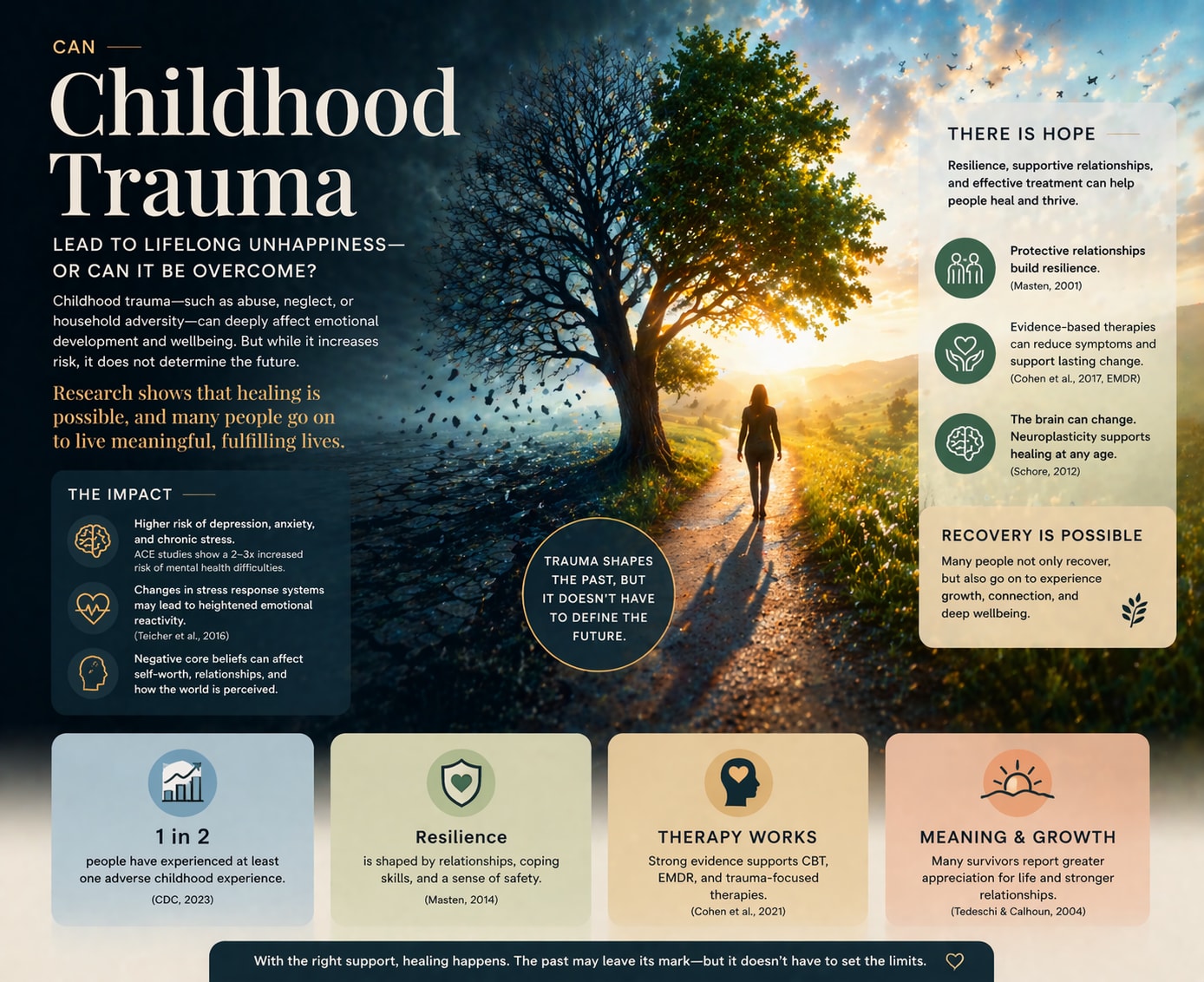
Research provides a clear starting point. Large-scale longitudinal studies, particularly the Adverse Childhood Experiences (ACE) studies conducted by Felitti et al. (1998), demonstrate a strong dose-response relationship between early adversity and later mental health outcomes. Individuals with higher ACE scores are significantly more likely to experience depression, anxiety, and reduced life satisfaction in adulthood. Subsequent meta-analyses have reinforced these findings, showing that childhood maltreatment is associated with a two- to threefold increased risk of developing mood and anxiety disorders across the lifespan.
Neurobiological research offers further insight into why these patterns can persist. Early trauma has been linked to alterations in brain systems involved in stress regulation, including the hypothalamic-pituitary-adrenal (HPA) axis and limbic structures such as the amygdala. Studies by Teicher and colleagues have shown that individuals with histories of childhood adversity may exhibit heightened threat sensitivity and difficulties with emotional regulation. These adaptations, while initially protective in unsafe environments, can contribute to chronic anxiety, low mood, and a persistent sense of unease in adulthood.
From a psychological perspective, childhood trauma can also shape core beliefs about the self, others, and the world. Cognitive models suggest that early adverse experiences may lead to enduring schemas such as “I am not safe,” “I am not worthy,” or “Others cannot be trusted.” These beliefs can influence how individuals interpret experiences, often biasing attention toward threat and reinforcing negative emotional states. Attachment theory similarly highlights how early relational trauma can affect patterns of intimacy and security in adult relationships, which are closely linked to long-term wellbeing.
Taken together, this body of research might suggest a deterministic conclusion—that early trauma leads inevitably to lifelong unhappiness. However, this is not supported by the evidence. While childhood trauma increases risk, it does not determine outcome. A substantial proportion of individuals exposed to significant adversity do not go on to develop chronic psychological difficulties. This phenomenon is often described in terms of resilience.
Longitudinal studies indicate that resilience is shaped by a range of protective factors. These include supportive relationships, particularly with at least one stable and responsive adult, as well as individual factors such as cognitive flexibility, emotional awareness, and problem-solving skills. Research by Masten (2001) describes resilience not as a rare trait, but as “ordinary magic”—a set of adaptive processes that can develop over time.
Importantly, psychological intervention also plays a critical role. Evidence-based therapies such as trauma-focused cognitive behavioural therapy (TF-CBT), Eye Movement Desensitisation and Reprocessing (EMDR), and schema therapy have been shown to significantly reduce the long-term impact of trauma. Meta-analyses consistently demonstrate moderate to large effect sizes for these interventions in reducing symptoms of post-traumatic stress, depression, and anxiety.
At a neurobiological level, there is increasing evidence for the brain’s capacity for change, even after early adversity. The concept of neuroplasticity suggests that with repeated therapeutic experiences—such as developing new ways of interpreting thoughts, regulating emotions, and forming relationships—neural pathways can be reshaped. This supports the clinical observation that meaningful psychological change is possible well into adulthood.
That said, it is equally important to adopt a balanced perspective. Recovery from childhood trauma is rarely a linear or complete erasure of past experiences. Some individuals may continue to experience vulnerability to stress, or patterns of thinking and feeling that reflect earlier adaptations. In this sense, trauma can leave a lasting imprint. However, this does not equate to a life defined by unhappiness. Rather, many individuals develop a different relationship with their past, one that allows for stability, fulfilment, and psychological wellbeing.
There is also variability in how individuals define “recovery.” For some, it involves a significant reduction in symptoms; for others, it may involve greater self-understanding, improved relationships, or the ability to live meaningfully despite ongoing challenges. This aligns with contemporary therapeutic approaches, which focus not only on symptom reduction but also on broader measures of wellbeing and functioning.
In clinical practice, the question is therefore not whether childhood trauma can be erased, but whether its impact can be understood, processed, and integrated in a way that reduces suffering and enhances quality of life. The evidence strongly suggests that it can.
Ultimately, childhood trauma increases the likelihood of later psychological difficulties, but it does not fix an individual’s future. With the right conditions—supportive relationships, adaptive coping strategies, and evidence-based psychological intervention—many individuals are able to move beyond the constraints of early adversity. Unhappiness is not an inevitable outcome. Recovery, in a meaningful and lasting sense, remains both possible and well-supported by the psychological literature.