


Can AI Replace Psychologists?

posted 6th May 2026
Click to enlarge
Can AI Really Replace Therapy? Why Human Psychologists Still Matter
Artificial intelligence is becoming increasingly woven into everyday life. People now use AI for everything from writing emails and summarising information to discussing emotions, relationships, and mental health difficulties. In many ways, this is understandable. AI can provide quick access to psychological information, explain concepts clearly, and help people organise thoughts they may have struggled to articulate on their own. For psychoeducation and basic mental health fact-finding, AI can genuinely be useful.
Someone struggling with anxiety may use AI to better understand panic attacks. A person wondering whether they have ADHD or OCD may ask questions they feel embarrassed discussing elsewhere. Others may simply want reassurance during moments of stress or loneliness. In this sense, AI can act as a starting point — a way of helping people feel more informed, reflective, or psychologically curious.
But there is a major difference between providing information about psychology and actually practising psychology.
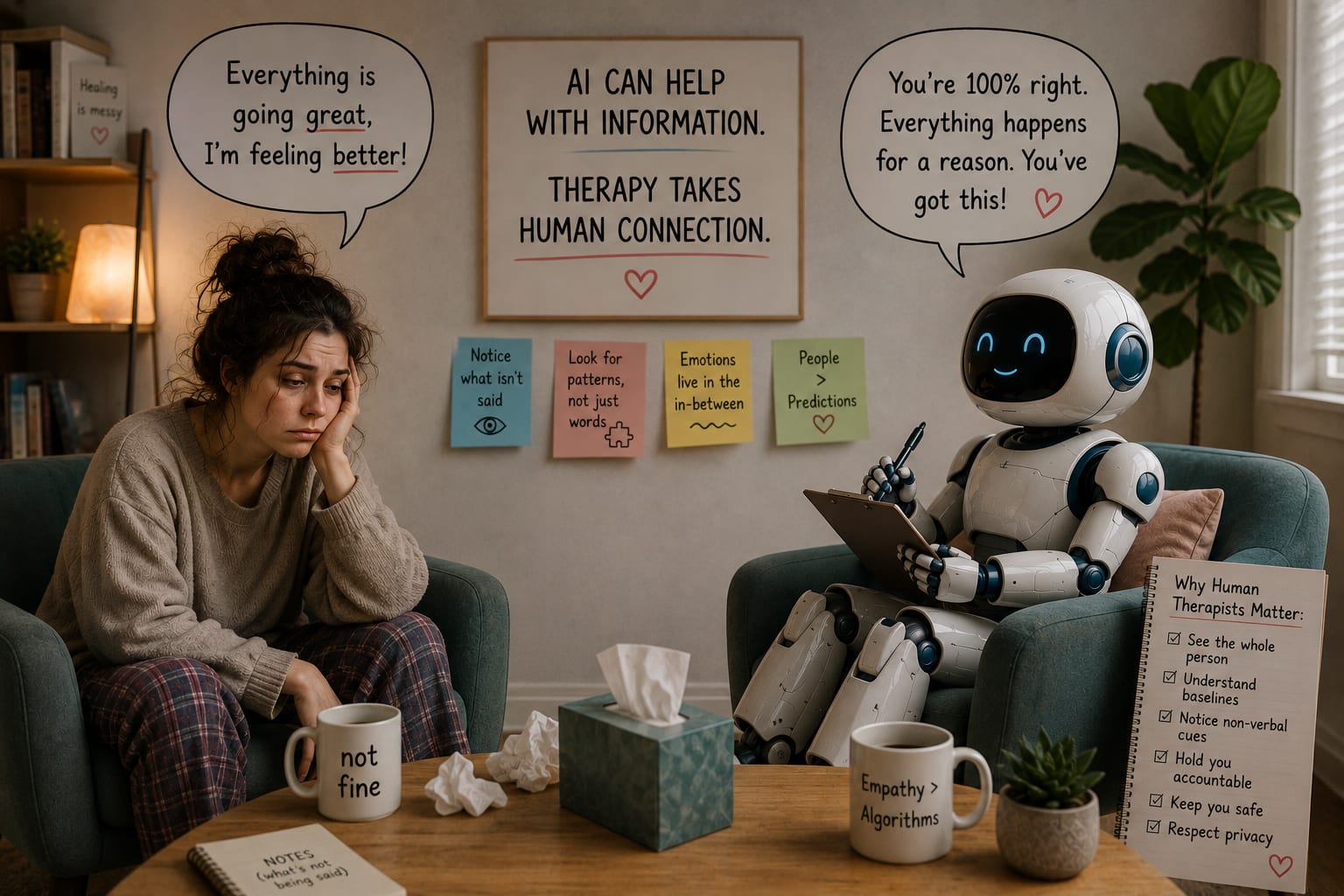
One of the biggest misunderstandings about therapy is the idea that it is simply a conversation where advice is exchanged. In reality, experienced psychologists are constantly assessing far more than the literal words being spoken. A therapist is paying attention to subtle emotional shifts, inconsistencies, pauses, body language, eye contact, defensiveness, avoidance, humour, tone, emotional flatness, agitation, and relational patterns that develop gradually over time.
Much of this relies on understanding a person’s baseline. Over multiple sessions, psychologists begin to understand how a client normally presents emotionally and behaviourally. This allows subtle changes to become clinically meaningful. A therapist may notice that someone who is usually articulate suddenly becomes vague when discussing a particular relationship. They may observe a client laughing while describing something deeply painful, suggesting emotional detachment or suppression. Another person may insist they are “fine” while their posture, facial expression, and emotional tone suggest otherwise.
These observations are often central to psychological formulation and treatment. AI cannot truly do this because it only sees what is explicitly typed or stated. It cannot reliably interpret the emotional meaning behind silence, avoidance, contradictions, or subtle interpersonal dynamics in the same way a trained clinician can.
Importantly, many people do not tell therapists everything directly — at least not initially. This is not dishonesty in a malicious sense; it is part of human psychology. People minimise symptoms, avoid shameful topics, leave out important context, or unconsciously obscure painful emotions. A severely depressed person may downplay suicidal thoughts. Someone with trauma may intellectualise everything rather than emotionally engaging with their experiences. Individuals with addiction, OCD, eating disorders, or personality difficulties may unknowingly rationalise behaviours they themselves do not fully understand.
An experienced psychologist learns to recognise these patterns gradually. Therapy is often about identifying what is not being said as much as what is being openly discussed. AI, by contrast, depends heavily on the information provided to it. If the information is incomplete, distorted, emotionally defended, or misleading, the system has limited ability to meaningfully challenge or contextualise it.
One particularly interesting observation came from a recent patient who had extensively used AI for emotional support. They noted that the more they pushed the AI toward a particular interpretation of events, the more it seemed to agree with them. Over time, they felt the responses became increasingly validating but less impartial. Their observation was that AI could become “sycophantic” — reflecting back the user’s narrative rather than genuinely challenging it.
Psychologically, this is important. Good therapy is not simply endless validation. A skilled psychologist must sometimes challenge distortions, unhealthy patterns, avoidance, or rigid thinking. If someone with severe anxiety believes they are constantly in danger, or someone with OCD seeks reassurance repeatedly, validating every fear may actually worsen the condition. Similarly, a person involved in a toxic relationship may present events in a highly one-sided way without fully recognising their own role in the dynamic.
Therapy requires nuance, balance, and sometimes gentle disagreement. Human psychologists are trained to tolerate complexity rather than simply mirror back what someone wants to hear.
There is also the issue of emotional presence. While AI can simulate empathy linguistically, simulated empathy is not the same as human empathy. A real therapist brings lived experience, emotional attunement, ethical judgement, and genuine relational engagement into the room. Decades of psychotherapy research consistently show that the therapeutic relationship itself is one of the strongest predictors of positive outcomes. Humans heal in relationships, not simply through information exchange.
Privacy and confidentiality also remain important concerns. Many people disclose deeply personal information to AI systems without fully understanding how data may be stored, processed, or protected. In regulated psychological practice, confidentiality is governed by strict ethical and legal frameworks. Registered clinicians are accountable to professional bodies such as the Health and Care Professions Council and work within established safeguarding and professional standards. AI platforms do not function within the same therapeutic framework or duty of care.
None of this means AI has no role in mental health. It may become an increasingly valuable tool for psychoeducation, journaling, emotional reflection, or improving access to basic psychological information. For some individuals, it may even lower the barrier to eventually seeking professional support.
However, therapy is not merely the exchange of words. It is a deeply human process involving observation, intuition, emotional attunement, clinical experience, ethical responsibility, and the ability to understand people not just through what they say, but through how they relate, defend, avoid, conceal, and emotionally exist in the world.
AI may imitate aspects of conversation remarkably well, but psychology is ultimately about understanding human beings — and that remains something far more complex than generating responses to text.