


Boxed In By Labels
posted 2nd June 2026
Boxed In By Labels: Why Psychology Warns Against Reducing People to Personality Types
Walk into any bookshop or scroll through social media and you will quickly encounter countless personality labels. Introvert. Extrovert. Leader. Follower. Overthinker. Sensitive. Strong. Confident. Anxious.
Human beings seem to have an endless desire to categorise themselves and others.
While labels can sometimes help us understand aspects of our experiences, psychology suggests they can also become surprisingly limiting. The problem is not that these descriptions are entirely inaccurate. The problem is that they often capture only a small part of a much larger picture.
Many people spend years defining themselves by a single characteristic. They become "the anxious one" in the family, "the quiet one" at work, or "the confident one" amongst friends. Over time these descriptions can become deeply embedded identities that influence how people see themselves and what they believe they are capable of achieving.
Modern psychological research paints a far more complex picture of human personality. Rather than existing as fixed categories, personality traits typically exist along a spectrum and change depending on context, circumstances and life experiences. A person who appears confident in one environment may feel deeply uncertain in another. Someone who is quiet in large groups may be highly expressive amongst close friends. Human behaviour is rarely as straightforward as the labels we attach to it.
One of the dangers of personality labels is that they can become self-fulfilling prophecies. When individuals repeatedly hear that they are shy, anxious, difficult, sensitive or lacking confidence, they may gradually begin to act in ways that reinforce those beliefs. What began as a description slowly transforms into a limitation.
This is particularly relevant in relation to mental health. People often describe themselves as being "an anxious person" or "a depressed person" rather than recognising anxiety and depression as experiences they are currently having. While this distinction may appear subtle, it can have a powerful impact on how individuals view their ability to change and grow.
Psychologists have long recognised that identity influences behaviour. If people believe they are permanently defined by a label, they may become less likely to challenge themselves, pursue opportunities or develop new skills. They may avoid experiences that conflict with the story they have constructed about who they are.
The reality is that human beings are remarkably adaptable. Confidence can be developed. Communication skills can improve. Emotional resilience can grow. The characteristics that feel permanent today may look very different in five years' time.
This does not mean labels are always harmful. They can provide language for experiences that previously felt confusing or isolating. Problems arise when labels replace curiosity. Rather than asking who a person is, we begin assuming we already know.
Perhaps the most helpful approach is to view labels as descriptions rather than definitions. They may tell us something about a person, but they never tell us everything.
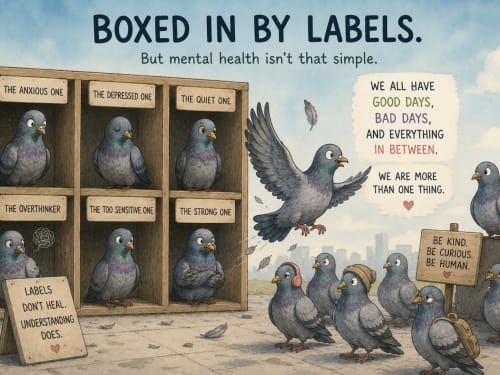
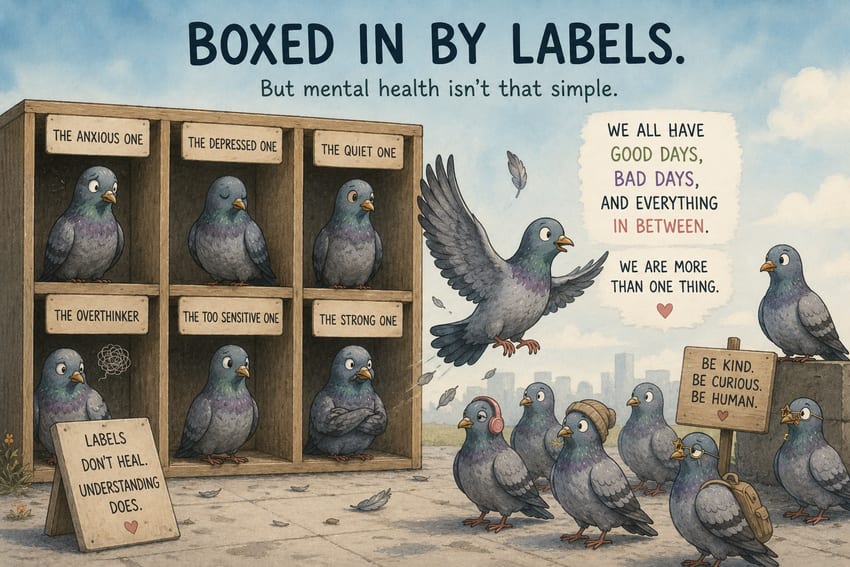
The image above captures this idea perfectly. A pigeon placed inside a box labelled "the anxious one" or "the quiet one" remains far more than the label attached to it. The same is true for people. We all have strengths, vulnerabilities, good days, bad days and endless capacity for growth.
The goal of psychological wellbeing is not to find the perfect label.
It is to understand ourselves deeply enough that we no longer need one.
Book a Consultation
If you feel limited by long-standing beliefs about your personality, confidence or mental health, therapy can help you explore where these beliefs originated and whether they still serve you. Understanding yourself more fully often reveals that you are far more than the label you have been carrying.