


Are You a Type A, Type B or Type C Personality?
posted 29th May 2026
Click image to enlarge
Are You a Type A, Type B or Type C Personality? The Psychology Behind Personality Labels and Why Human Beings Are More Complex Than Three Categories
Popular culture loves personality labels. Whether it is Myers-Briggs, introvert versus extrovert, or the classic Type A and Type B personality theory, people are naturally drawn to simple explanations for complex human behaviour. There is something deeply satisfying about identifying ourselves within a category. It helps us make sense of our strengths, weaknesses and relationships.
This fascination with personality types recently found its way into popular television through Jack Ryan, where personality classifications were referenced as a way of understanding behaviour and predicting how people might respond under pressure. Whilst such frameworks can be useful, psychologists have long debated how accurately they capture the complexity of real human personalities.
The truth is that most people are not purely Type A, Type B or Type C. Human beings are considerably more complicated than that.
Where Did Type A and Type B Personalities Come From?
The Type A and Type B personality concept emerged in the 1950s through the work of cardiologists Meyer Friedman and Ray Rosenman. They were interested in understanding why some individuals appeared more vulnerable to heart disease than others despite having similar physical health profiles.
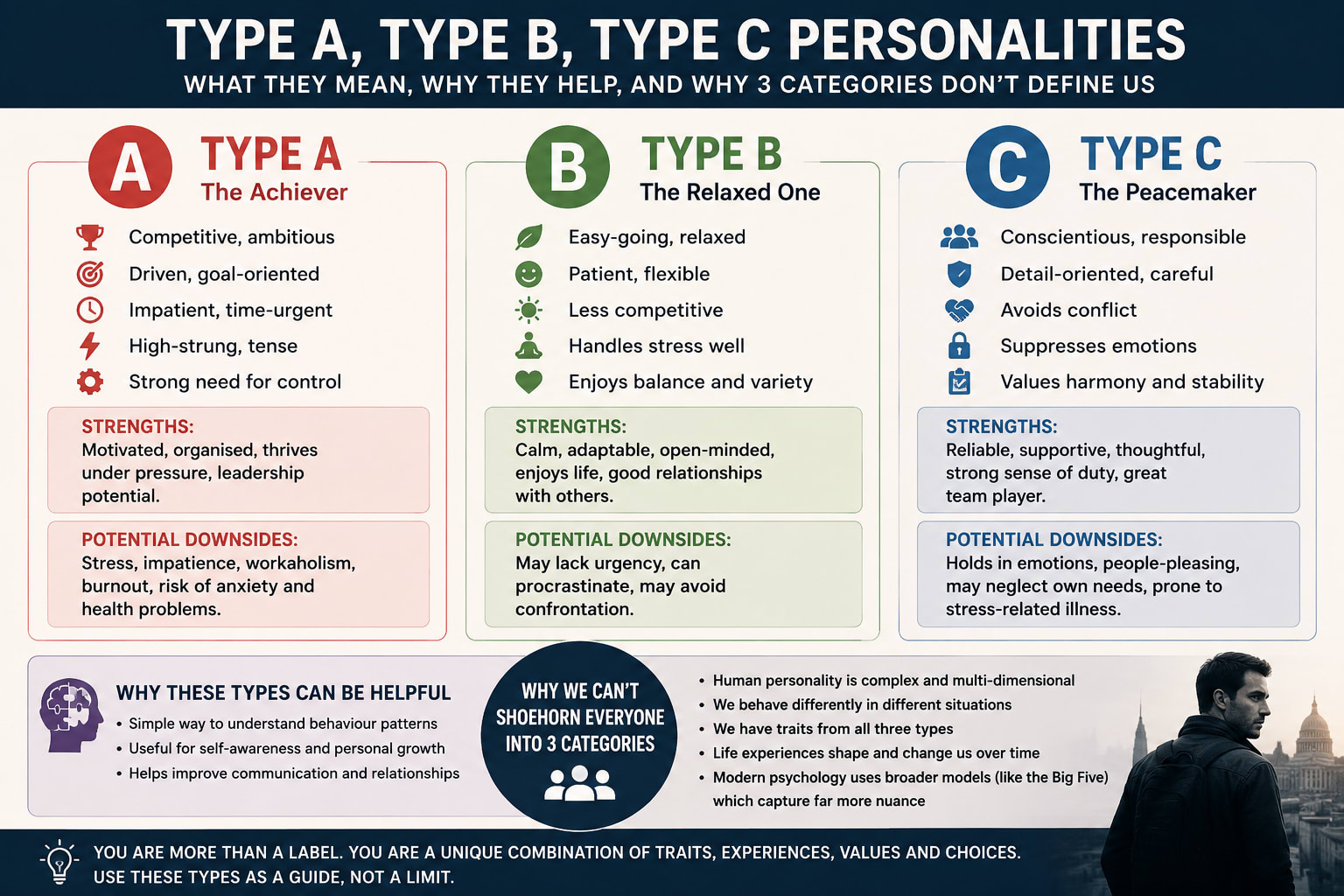
Their research led them to identify a pattern among certain patients. These individuals tended to be highly competitive, ambitious, impatient and driven. They often struggled to relax and seemed to be in a constant hurry. Friedman and Rosenman labelled this pattern Type A personality.
By contrast, Type B personalities appeared more relaxed, patient and easy-going. They were less concerned with competition, less likely to experience chronic stress and generally appeared more comfortable taking life at a slower pace.
The distinction became hugely popular because it seemed intuitive. Most people could immediately think of colleagues, friends or family members who fit one category more than the other.
What Is a Type A Personality?
Type A individuals are often highly motivated and achievement-oriented. They enjoy setting goals, measuring progress and pushing themselves towards success. Many entrepreneurs, executives, athletes and high achievers display Type A characteristics.
These individuals are frequently described as organised, disciplined and productive. They often thrive in competitive environments and may be highly effective under pressure.
However, the same qualities that contribute to success can sometimes create difficulties. Type A personalities are more likely to experience chronic stress, frustration and impatience. They may struggle to switch off, find relaxation uncomfortable and place enormous pressure on themselves to achieve.
Whilst society often celebrates these traits, living in a constant state of urgency can come at a psychological cost.
What Is a Type B Personality?
Type B individuals tend to approach life differently. They are generally more relaxed, flexible and less driven by competition. Rather than viewing every challenge as something to be won, they may focus more on enjoyment, relationships and personal satisfaction.
This does not mean Type B personalities lack ambition. Rather, they are often less likely to define their self-worth through achievement alone.
Many Type B individuals cope well with uncertainty and tend to experience lower levels of stress. They may appear calmer under pressure and less reactive when things go wrong.
The downside is that they can sometimes be perceived as lacking urgency or motivation, particularly in highly competitive environments. However, this is often a misunderstanding. Their priorities are simply different.
What About Type C Personality?
Over time, psychologists and popular writers introduced additional categories, including the less widely known Type C personality.
Type C individuals are often described as conscientious, detail-oriented and conflict-avoidant. They tend to suppress emotions, particularly anger, and may prioritise harmony over confrontation. They are frequently dependable, thoughtful and highly responsible.
Many healthcare professionals, scientists, administrators and support-oriented individuals display characteristics commonly associated with Type C personalities.
Historically, some researchers suggested that Type C personalities might be linked to certain health outcomes due to emotional suppression. However, evidence for these claims remains mixed and controversial.
What is clearer is that people who consistently suppress emotions can experience increased psychological distress over time. Difficult feelings rarely disappear simply because we choose not to express them.
The Problem With Personality Labels
The appeal of personality categories is obvious. They simplify a complicated subject and make human behaviour easier to understand.
The problem is that simplicity is not always accuracy.
Most people are not purely Type A, Type B or Type C. A surgeon may display intense Type A characteristics at work whilst becoming completely relaxed and easy-going at home. An entrepreneur may be highly competitive in business but deeply conflict-avoidant in relationships.
Context matters enormously.
Human beings adapt their behaviour depending on their environment, responsibilities, relationships and life experiences. Personality is not a fixed costume that we wear every day. It is far more fluid and dynamic than popular models often suggest.
This is one reason modern psychology has largely moved away from rigid personality categories.
How Modern Psychology Views Personality
Today, most personality researchers favour dimensional models rather than categories.
One of the most influential is the Big Five Personality Model, which measures individuals across five broad dimensions: openness, conscientiousness, extraversion, agreeableness and neuroticism.
Rather than asking whether someone is Type A or Type B, modern psychology recognises that people exist along multiple continuums.
For example, you might score highly on conscientiousness, moderately on extraversion and low on neuroticism. Another person may display a completely different combination.
This approach reflects reality more accurately because it acknowledges that personality is made up of many overlapping traits rather than a single label.
Why We Love Personality Categories Anyway
Despite their limitations, personality labels continue to thrive because they satisfy a basic human need.
People want to understand themselves.
They want explanations for why they think, feel and behave the way they do. Categories provide certainty in a world that often feels complicated and unpredictable.
They also help us understand others. It is easier to say "he is a Type A personality" than to describe the dozens of traits, experiences and motivations influencing someone's behaviour.
The danger arises when we start treating labels as facts rather than frameworks.
Once people adopt a label, they may begin behaving in ways that reinforce it. Someone who believes they are naturally Type A may become reluctant to rest. Someone who sees themselves as Type B may avoid challenges because they believe they are simply not competitive.
The label becomes a limitation rather than a description.
Personality frameworks such as Type A, Type B and Type C can be useful starting points for self-reflection. They can help us recognise patterns in our behaviour, understand our stress responses and appreciate differences between ourselves and others.
However, they should never be mistaken for complete explanations.
Human beings are far too complex to fit neatly into three categories.
You are not simply Type A, Type B or Type C.
You are a unique combination of genetics, life experiences, relationships, values, motivations and personal choices. Whilst personality labels can offer insight, they should be viewed as maps rather than destinations.
The most interesting thing about human psychology is not how similar we are.
It is how wonderfully complicated we remain.